Gun Reviews >
 Find a Dealer >
 Find a Club >
 Competitions >
 videos >
 Reader Survey >
Anschütz 9015 HP ONE review: what £4,740 buys the target shooter
- Last updated: 25/09/2026




Dave Barham gets his hands on the most expensive and most adjustable air rifle he has ever tested, the £4,740 Anschütz 9015 HP ONE Field Target, and finds it will only ever shoot as well as the person behind it.
If any maker can claim to build the Rolls-Royce of airguns, it is Anschütz. The German firm has been making target rifles since 1856, and its smallbore rifles, the famous Match 54 among them, have ruled international competition for decades.
The 9015 HP ONE Field Target is its flagship PCP match air rifle. It is designed for ISSF 10m competition but is just as much at home in FT and HFT. It is a single-shot .177 built to put pellet after pellet through the same hole at 10m, and everything about it, from the balance to the adjustment and the trigger, is aimed at consistency under match pressure.
Anschütz puts it like this: “Any time around a 10m air rifle range, at a club, a county championship, or watching Olympic qualifying, you will have seen the 9015 on the firing line. It has become the benchmark precision match air rifle of its generation, and for British target shooters looking to move up from a club gun to something genuinely competitive, it is usually the first name on the shortlist.” I would not argue. It is a remarkable rifle.
Prices are RRP at the time of publication and may since have changed.
The 9015 comes in several factory versions. The ONE on test is the top-of-the-range, fully adjustable competition model and the one most often seen in the UK, at around £4,740.
For newer shooters there are Club editions with a simpler stock at a lower price, and Junior versions with shorter stocks.
It arrives in a synthetic rifle case, with a full toolkit in a separate compartmented plastic box that holds everything needed to set the rifle up for you.
I will admit I was out of my depth. I seldom shoot competitions and know little about tuning a rifle; I simply enjoy shooting. Lifting a beautiful rifle bristling with adjusters out of the box took me aback, and my first thoughts were along the lines of what is this for, and where does that go?
A quick read of the manual and a great deal of fiddling got me set up about as well as my limited knowledge allowed, and then it was time to fit a scope and head for my garden range.
Before any setting up, the rifle needed filling. There is no Foster connector. Instead the cylinder comes off the rifle and screws straight onto a dive bottle through the brass coupler supplied. It was new to me but very easy. Fit the coupler to your bottle’s main thread with a spanner and screw the cylinder into the other end. Tighten the bleed valve on the coupler, fill to 200 bar, shut the bottle’s fill knob and open the bleed valve again. The cylinder then slides back into the long carbon shroud under the barrel and screws home. A fill gives about 100 shots, plenty for a match, but if you plan to enjoy it at the club, a spare cylinder or two will mean more shooting and less filling.
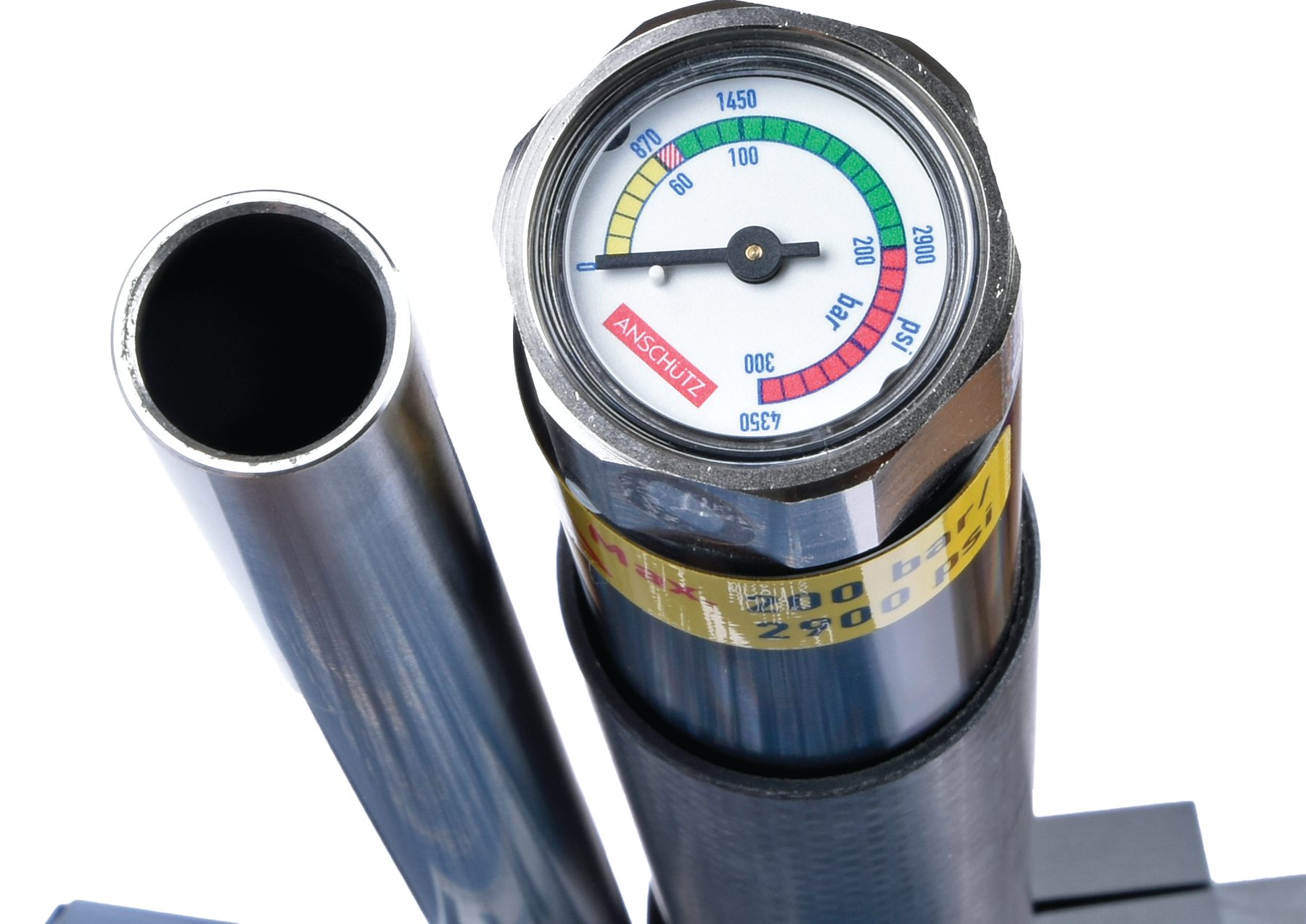
There is no Foster connector: the cylinder comes off and screws to the dive bottle through the brass coupler supplied
This was what worried me most: all those adjusters hanging off the skeleton butt. The top and bottom hooks are self-explanatory, fitting the shoulder above and under the armpit. The three smaller pieces are for fine-tuning, so the rifle beds in rock solid every time you mount it. It can be made to fit like a glove.
On top of that, the whole assembly pivots in every direction you can think of. The adjustment is effectively endless, and you would struggle not to get a perfect fit. I have never come across anything like it.
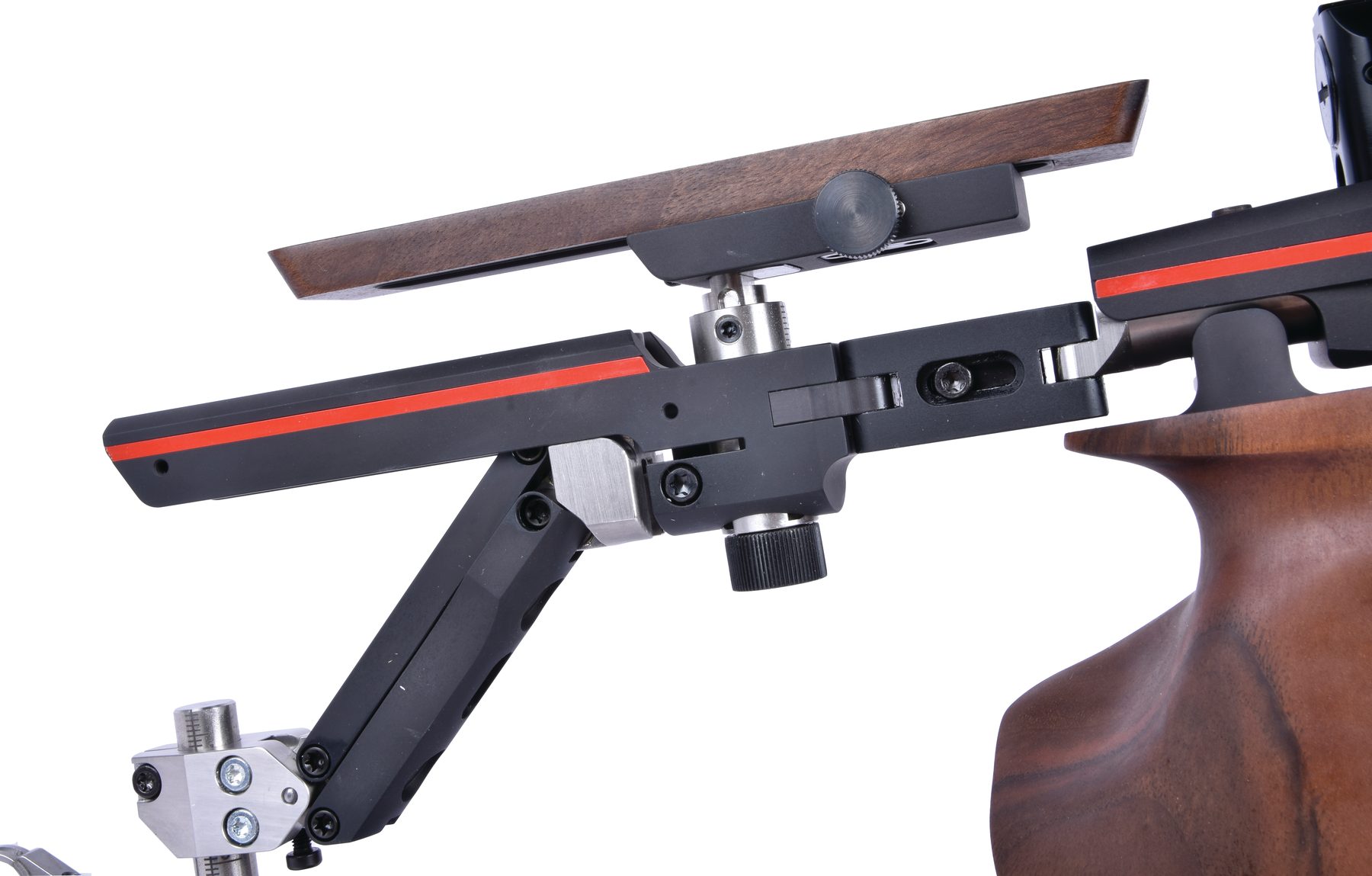 Hooks top and bottom, three fine-tuning pieces, and the whole unit pivots
|
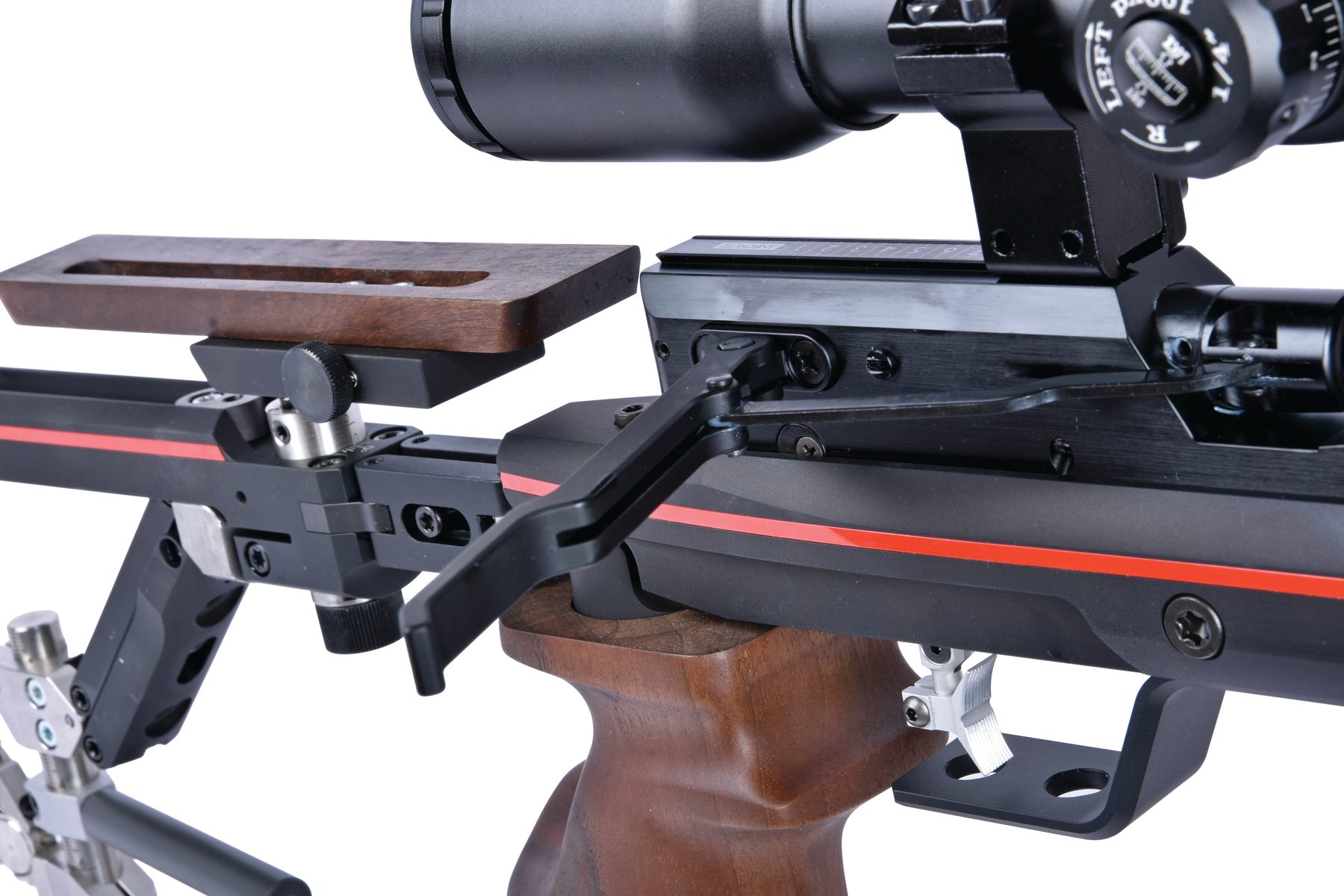 Cheekpiece height and cast, butt position and angle, all with etched scales
|
The 9015 is really a fitting system more than a fixed rifle. Cheekpiece height and cast, butt plate position and angle, grip angle and forend height, in fact every point where you touch it, can be set to your liking. It is all done with hex (Allen) screws, and there are a lot of them, but the case holds a complete toolkit so you need nothing extra.
As if that were not enough, five quick-release levers are supplied to replace many of the hex screws on the butt, forend and elsewhere, so you can make changes on the firing point without the tools.
I did not bother swapping the screws for levers. I spent a little while setting the rifle up for me, locked it all down with the tools and got on with it. I could not wait to shoot the thing.
The forend hamster is sold as a VARIO palm rest and adjusts for swivel and height like everything else. Etched scales are everywhere, on the dovetail rail, on the butt plate angle and on the cheekpiece height, so once you have the fit right you can write every setting down.
Even the walnut pistol grip adjusts in every direction, and it comes in three sizes for different hands, men, women and children alike. The test rifle had the large; medium and small are also offered. Each is machined from walnut and oiled, smooth and luxurious to hold, and beautifully shaped.
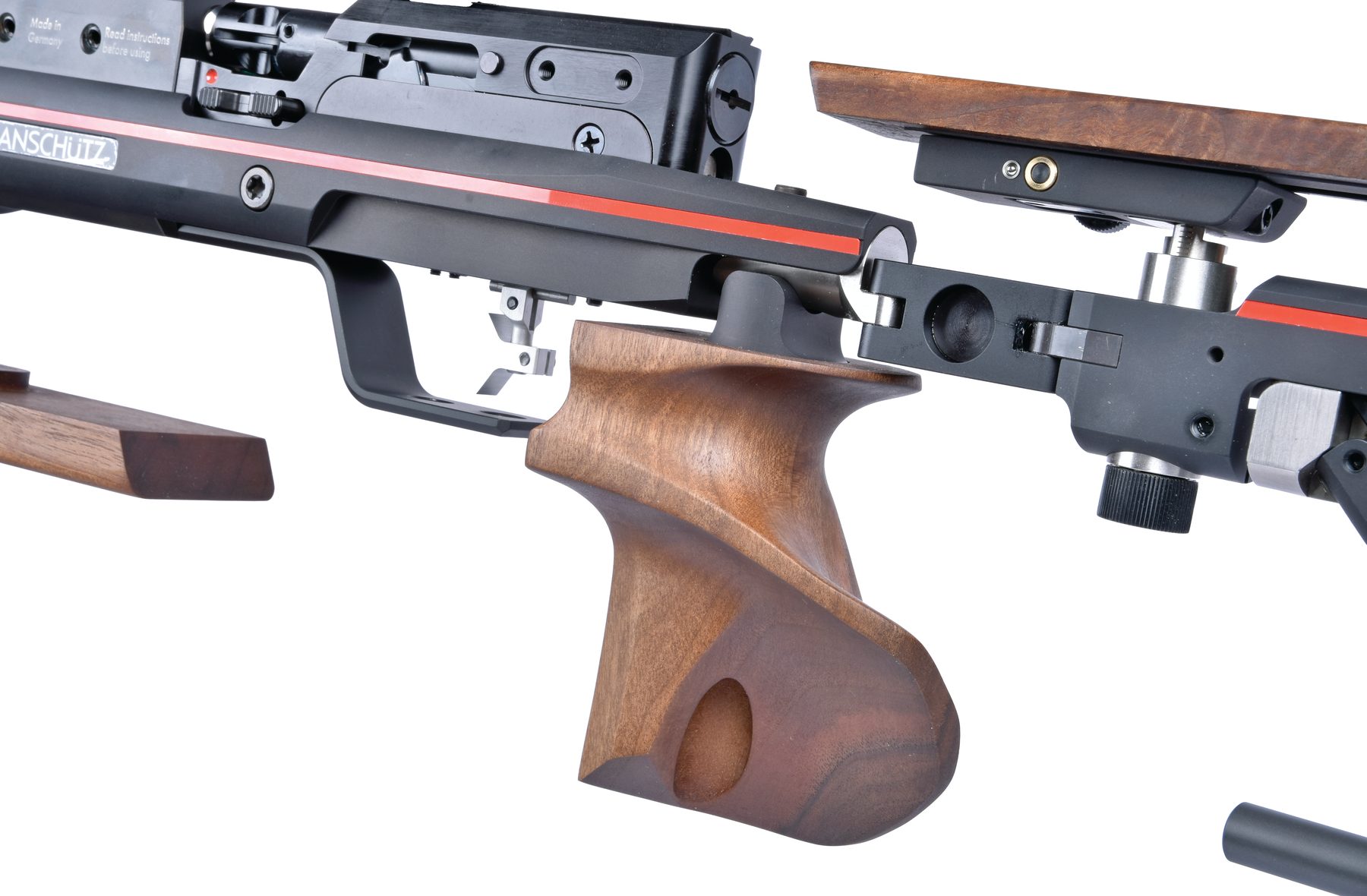 The oiled walnut grip comes in three sizes; this is the large
|
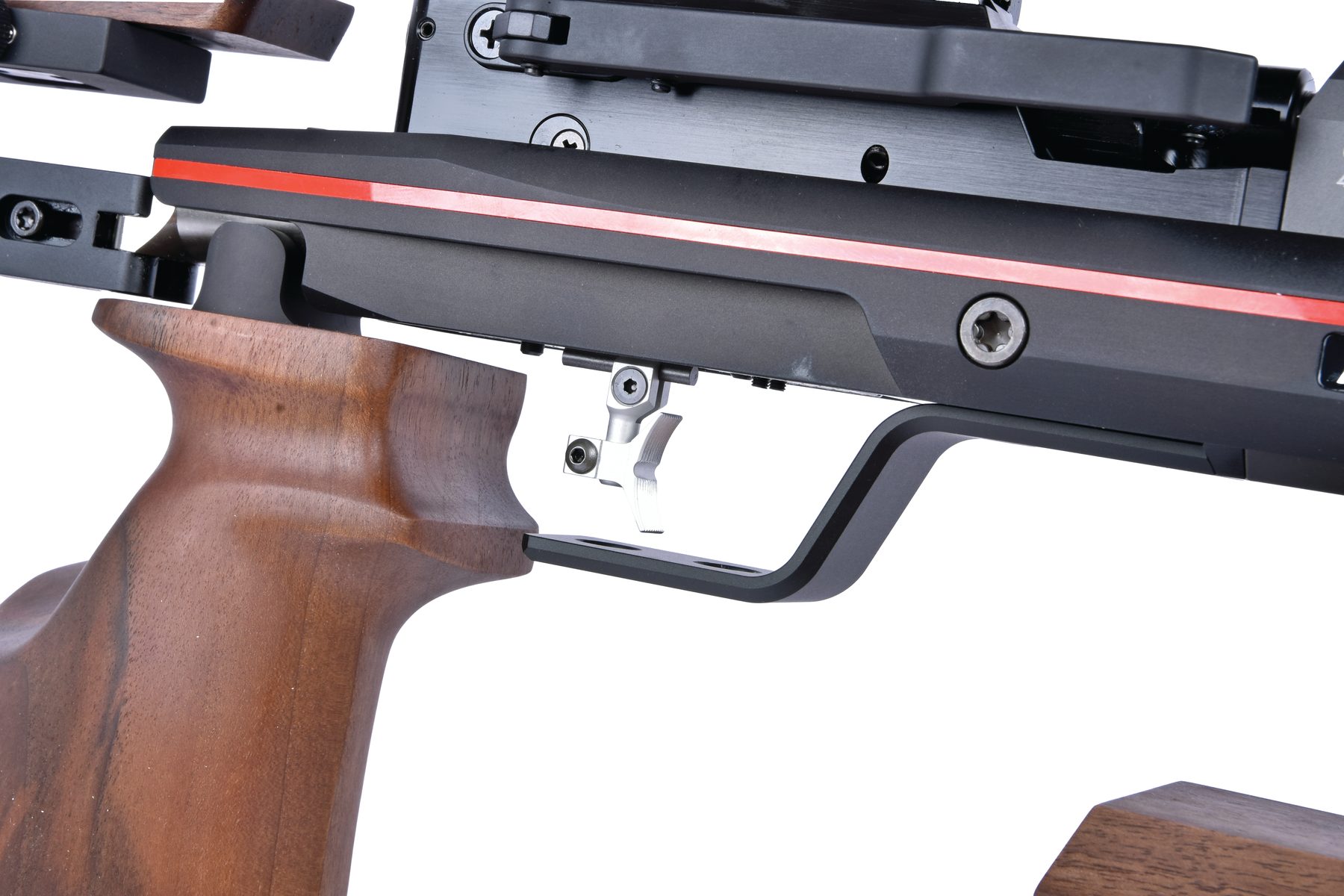 The 5065 4K trigger adjusts from 30g to 170g and leaves the factory at 100g
|
The sidelever is a clever design, and there is no pellet probe. Pull the lever back and the bolt draws back to open a pellet port. You drop the pellet in by hand and close the lever, which pushes the bolt forward and shuts the port. It is very slick, and because nothing presses on the pellet, there is no risk of damaging the skirt or the head. Loading could hardly be better.
Once loaded, a toggle safety sits just below the port on the left. Press the back of it for Safe and the front for Fire. Again, very straightforward.
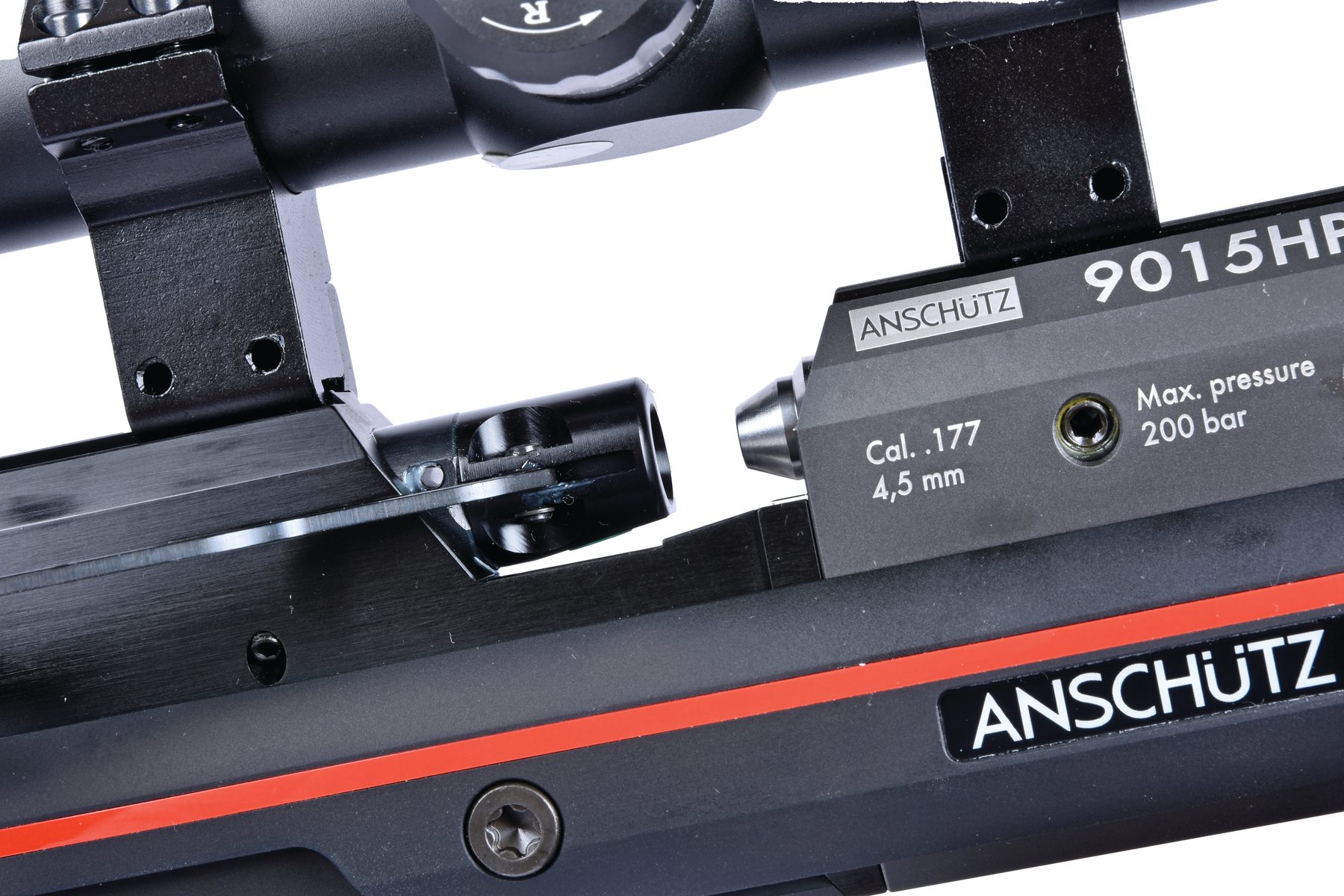 No probe: the bolt draws back to open the port and the pellet goes in by hand
|
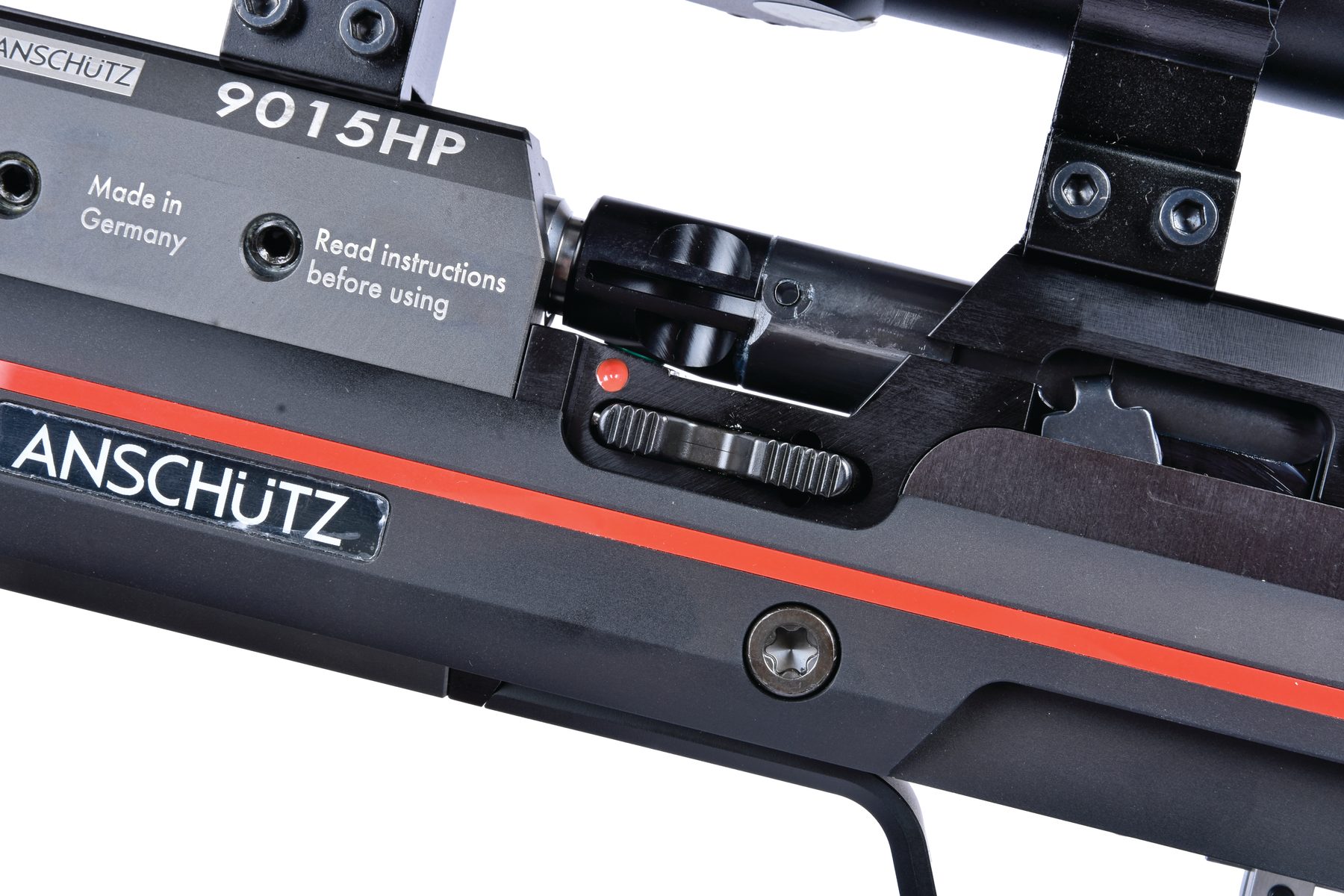 Model, calibre and maximum pressure stamped where you can read them
|
Anschütz match triggers are widely rated among the best there are, with adjustment for weight, travel and position so the release can be set exactly as you want it.
This is the newest 5065 4K unit, and it is very easy to set up. Its axial ball bearing (4K meaning four balls) holds the trigger blade with no backlash at all, which is where its performance comes from.
The manual has clear diagrams showing which grub screw does what for first-stage pull, first-stage travel, weight and break. Sear engagement is set at the factory for the best result.
The blade is wide, gently curved alloy and can be moved sideways, lengthways, up and down and rotated. On my test rifle the first stage was very short and the break extremely light. It comes set at about 100g but is easily adjusted anywhere from 30g to 170g. There is no creep whatsoever, and I soon got used to it. It is a joy to use, even though it breaks far lighter than almost any other rifle I have shot.
The Anschütz barrel needs no introduction; it is world class. Here it is 20.1in long and can be tuned. I have not come across anything more mechanically consistent than this rifle.
The action and regulated air system give steady velocities shot after shot, so at 10m the group size depends on the shooter, not on the rifle.
I started on my wobbly garden bench with a target at 10m, using QYS Olympic-grade 8.2gr flatheads. It is an Olympic-grade rifle, after all, so matching pellets seemed only right.
The 10m results were as good as I had hoped, with a single flyer at top left that was down to me and the bench. I have no doubt that with the rifle clamped in a vice, ten shots at 10m would leave one hole and nothing more.
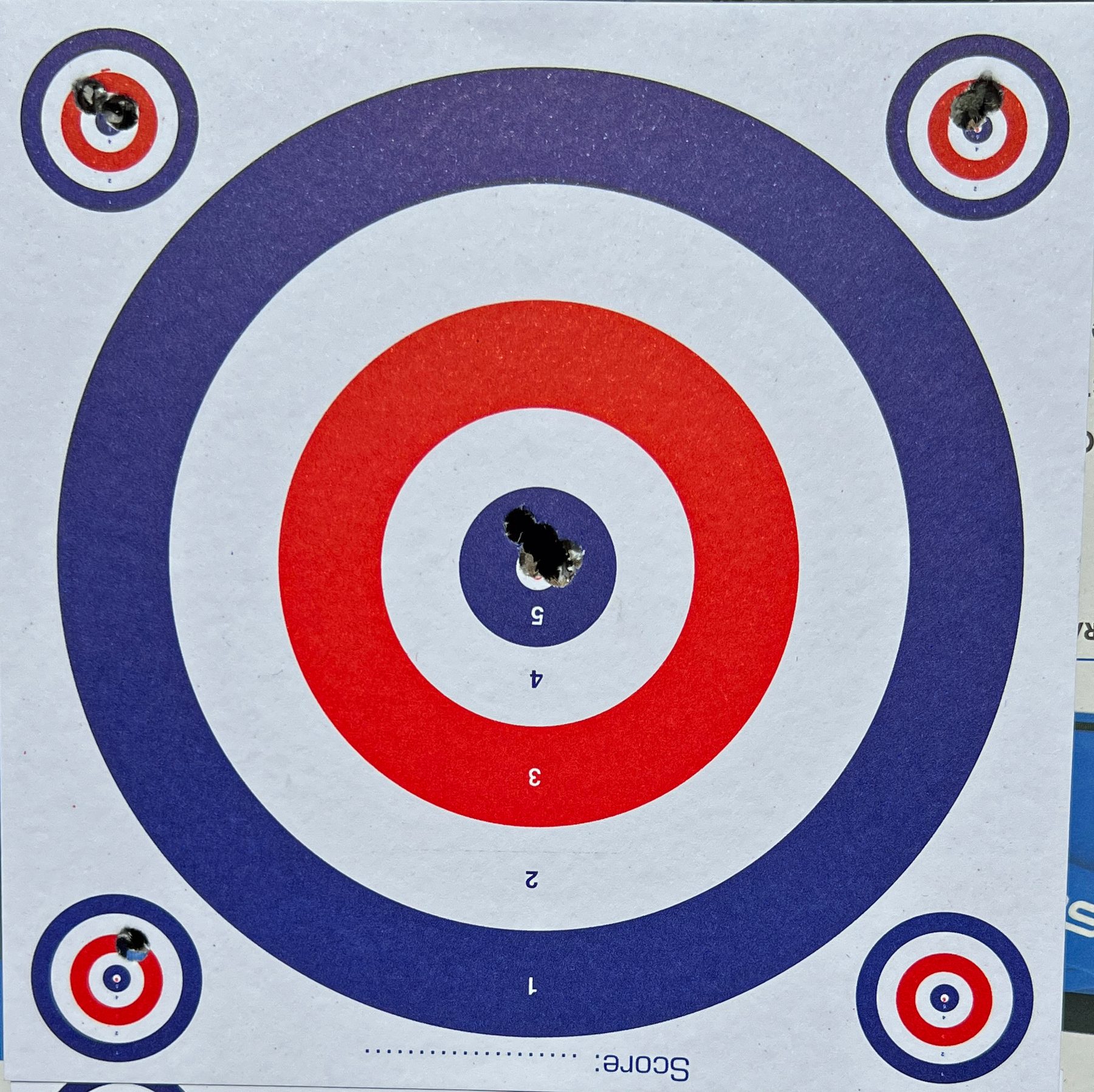 QYS Olympic-grade 8.2gr at 10m; the flyer at top left was the bench, not the rifle
|
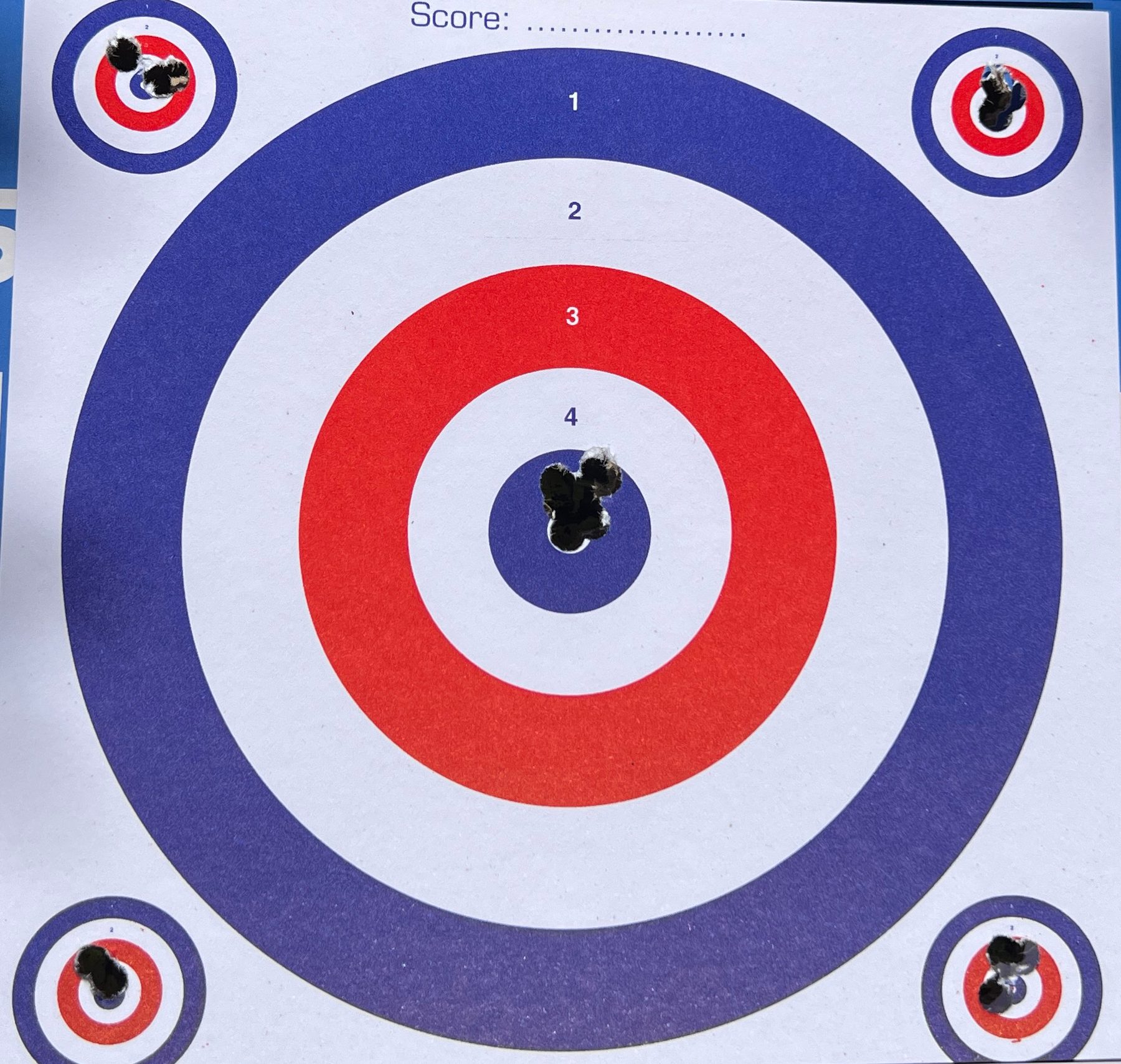 One ragged hole at 10m
|
At my club range I took the same pellets out to 30m, where I normally begin testing other rifles, and the groups were nearly as tight as at 10m. At 40m the spread barely grew again. I have never shot to that standard before, and I loved it. There is far more to this rifle than I first thought, and as I write this all I want to do is get back on the range and put another 100 pellets through it.
For a club shooter ready to step up to a genuine competition rifle, the 9015 is the benchmark, and it lives up to it. The fit can be tailored to a degree I have never seen, the trigger is superb and the accuracy is limited only by the person holding it. It asks for time and patience to set up, and a dive bottle to fill it, but it repays both.
Around £4,740 for the fully adjustable ONE model on test, through UK distributor Viking Arms. The Club editions have a simpler stock and cost less, and the Junior versions have shorter stocks.
About 100 from a 200 bar fill of the 200cc cylinder, which covers a match with room to spare. For club shooting, a second cylinder cuts down the time spent filling.
Take the cylinder off the rifle and connect it to a dive bottle with the brass coupler supplied. Close the bleed valve on the coupler, fill to 200 bar, shut the bottle and open the bleed valve, then refit the cylinder in the carbon shroud under the barrel.
No. It is designed for ISSF 10m but suits field target and hunter field target too, and on test it grouped almost as tightly at 30m and 40m as at 10m.
Anschütz 1727 APR Competition review – the same maker’s precision rimfire on test.
QYS .22 domed pellets: two new heavyweight .22s tested – more from the pellet maker used in this test.