Gun Reviews >
 Find a Dealer >
 Find a Club >
 Competitions >
 videos >
 Reader Survey >
AIRMAKS ARMS KATRAN PRO C
- Last updated: 31/01/2025




So, back in the December issue, Mark Camoccio tested the AirMaks Krait Lite, and it was the first time that he had used an airgun from this manufacturer. Feeling like I was missing out, I decided that I wanted to have a go as well! After a quick call to Hawke Optics, the new distributor for AirMaks Arms, I was sent a Katran Pro C, which comes in at around £1400. As a fan of ‘tactical-style’ rifles in general, I think it looks great, and it didn’t take long for me to start noticing all the practical features that this type of rifle offers. So, let’s take a proper look!
Open it and find out
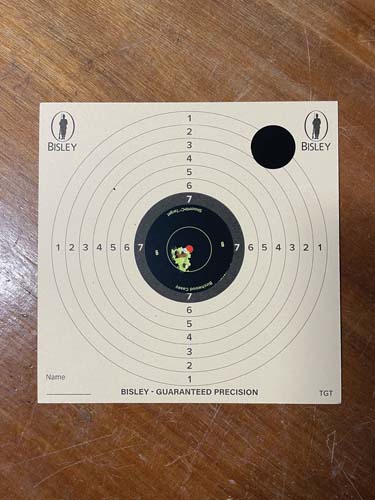
As you would expect, the Katran Pro C is available in .177 (on test), .22, and .25 in sub-12ft/lbs configuration, and .22 or .25 with a choice of choked barrel for pellet and unchoked barrel for slug if you fancy an FAC-rated version. The rifle arrived in its own compact hard case along with one magazine, some basic instructions, a target card showing a very tidy group, an inspection form, and a filler probe with spare seals. Importantly, the hard case is big enough to accommodate the rifle with a scope fitted as well. Hawke kindly sent an Airmax 30 SF 4-16x44, but I actually fitted a much larger Airmax 30 FFP SF 6-24x50, which I still managed to fit in the case! I was also sent an AirMaks silencer and a Picatinny accessory rail for a bipod.
Given the price tag of this rifle and the ‘C’ for compact in its name, I was very pleased to see that it comes sporting a folding stock. As standard (no attachments), it measures around 30.7” (780mm) in length, and when folded, a paltry 20.8” (530mm)! Weight-wise, we are looking at 2.86kg (6.31lbs), with the balance point fairly central, although this is bound to change once attachments are fitted. Overall, a sturdy, well-made rifle that boasts a matte black finish throughout and feels good in the hand.
The reason for the price
The ambidextrous chassis system fitted to the Katran looks great and definitely helps to justify the price of the rifle, and you soon realise the quality on hand when you fold the stock around to the left-hand side of the rifle using the solid, beautifully CNC-machined hinge. No flexing or slack in sight! To fold the stock, just depress a sprung button on the left to unlock the hinge, allowing the butt to glide around the side of the rifle until it meets a small magnet that secures it in place, preventing it from flapping about.
To help the shooter get the maximum out of the rifle, the 5” (160mm) long polymer cheekpiece can be adjusted using a single thumb wheel, giving approximately 20mm of extra height. It can then be locked off using two grub screws. The length of pull can also be adjusted using a thumb wheel, increasing it from 13.3” (340mm) to a fairly significant 14.9” (380mm). Want to adjust the height of the rubber butt pad? No problem—you just need an Allen key. To further boost the appeal of this rifle, the butt also shows some QD flush cups, so fitting a sling should not be an issue.
Look to the front of the rifle and you will see an 11.6” (295mm) aluminium fore-end that cradles a 165cc air cylinder with a manometer at its tip. The fore-end is bolted to the receiver via seven bolts, making it easy to remove, and features multiple M-LOK slots at 6, 9, and 3 o’clock, allowing the user to attach all sorts of accessories. A huge perk comes in the form of an integral ARCA rail, making it particularly easy to attach the rifle to a tripod, for example. The Katran is scoring highly so far!
It is worth mentioning at this point that when shooting from the bench, the layout of the butt did mean that I had to get a bit creative with my rear bags to make use of the flat area at the base of the butt for support. Do not fret, however, as there are several accessories that you can buy separately for the Katran, such as a bag rider and monopod.
Finally, we have the AR15-type rubberised pistol grip, which is actually a Fab Defense unit. In use, I found it a bit thin, especially when compared to the hand-filling ERGO grips I have on my rifles. No problem, though, as if you don’t like it, then you can swap it for something else! Modularity is king, after all.
Air and pellets
AirMaks states a max fill pressure of 300bar in the instruction manual, and filling is easy. Well, sort of! Having attached the fill probe to my dive bottle, I rotated the dust cover at the front of the air cylinder to expose the fill port. However, the angle/position of the port meant that I had to remove a portion of the barrel shroud (very easily done) to access it, which was a tad irritating! Anyway, I opted to fill the rifle to 250bar for all my testing, and I was pleased to discover you can even discharge the air tank if you want, which is useful.
As previously mentioned, you get one magazine with the rifle (18-shot in .177, 16 in .22, and 14 in .25). It is CNC-machined from aluminium and shows an exposed polymer spindle within. To load it, simply insert a pellet into each chamber while rotating the sprung spindle. Just be sure to cover the hole with a finger to prevent the pellet from falling through. Other than the possibility of dirt or rain getting into the open face of the mag while out hunting, the design of the mag is very good. Importantly, the rifle includes a clever anti-double feed system that can interrupt the magazine, which is a feature that I wish was on more airguns.
The barrel and more
An 11” (280mm) CZ barrel is housed within the shroud, and the overall length is increased by an additional 3” (75mm) shroud segment (the piece I had to remove to fill the airgun) that incorporates a ½” UNF thread for a silencer.
The rifle shows a 7” (180mm) length of uninterrupted aluminium Picatinny rail for scope mounting. It was, however, only just long enough to accommodate the large scope I fitted, primarily because of the 3.5” (90mm) of eye relief, so make sure you take this into account when selecting a scope.
The Katran features a well-placed, biathlon-style side-lever that’s located just above the trigger guard, and on opening, a third of its travel is spring-assisted, ensuring an efficient cocking stroke. As well as the safety catch, the lever is fully reversible, making it ideal for left-handed users as well. Impressive!
To load the rifle, pull the lever to the rear, then make sure the magazine is orientated so that the hole will line up with the barrel, and insert it from the right-hand side. Close the side-lever and you are good to go.
Trigger and safety
The Pro C comes with an AR15/fire-selector-type safety that is mounted on the left of the receiver. It is clearly marked and can easily be toggled using the thumb on the firing hand: up for safe and down for fire.
Trigger-wise, you get a sweet, fully adjustable unit that can be adjusted externally using an Allen key. Out of the box, it was very light, with a short first stage and a final pull weight of around 8.5oz. You can even move the trigger backwards or forwards to alter the reach, plus rotate the trigger shoe around its post and up or down. So, plenty to tinker with then. With a quality trigger being a key component on any accurate rifle, I was very pleased with this one.
So much testing
Right, with the big Hawke scope, the AirMaks silencer, and a Tier-One ELR bipod fitted, I was ready to collect some data. I used a selection of premium pellets for the test, and the first thing I want to talk about is the performance of the Huma-Air regulator that comes fitted to this airgun. I mean, look at the figures in the ammo table! All of them are 10-shot strings, but even after 89 shots using Baracuda 8 pellets straight from the tin, the rifle only produced an extreme spread of 23fps. I will take that all day long! However, given these excellent figures, I was surprised to find that accuracy, to begin with, was not all that, as I was plagued by flyers. I considered the possibility of the barrel being pellet-fussy and the fact that review rifles have a strange life, and decided to keep shooting to see if the barrel needed a bit of fouling. Well, as if by magic, it came on song after about 300 pellets, so there is a lesson in there somewhere! In the end, the JSB Exact Diabolo came out on top, boasting the best blend of accuracy, power, and velocity.
Shot count-wise, the literature states that with a 300bar fill, the Pro C should achieve 140 shots in .177 and .22. As stated, I filled the test rifle to 250bar, achieving around 89 to 96 shots before the consistency started to waver.
Conclusion
I really enjoyed my time with the Pro C, and I am only disappointed by the fact that I have to send it back. Yes, there were some negatives, such as the incredibly basic instructions and the fact I had to remove part of the shroud to fill it. However, it looks great, is compact, and comes packed with features and adjustability. It also offers amazing shot-to-shot consistency and became pretty darn accurate after enough pellets were sent down the tube. So, all in all, a great choice for anyone looking for this type of rifle.

click on image to enlarge

click on image to enlarge

click on image to enlarge

click on image to enlarge

click on image to enlarge

click on image to enlarge

click on image to enlarge

click on image to enlarge

click on image to enlarge

click on image to enlarge

click on image to enlarge

click on image to enlarge

click on image to enlarge
click on image to enlarge

click on image to enlarge