Gun Reviews >
 Find a Dealer >
 Find a Club >
 Competitions >
 videos >
 Reader Survey >
Brocock Ranger XR
- Last updated: 25/01/2022



The Ranger XR is Brocock’s new baby, and whilst gun’s of this type are so often launched at shooting shows, (something that’s understandably had to take a back seat for a while), the company has instead issued press releases, after a drip-feed of tantalizing info bytes on social media platforms.
My test rifle came in the usual boldly emblazoned protective box and I have to say that first impressions had me double-taking. For the Ranger XR, as supplied, comes without a silencer, and as such, at just 27.3” (adjustable) in length, looks pretty small. So, should we feel short-changed from £1244? Admittedly, that is a significant asking price, but look closer and this model has a raft of features aimed at a particular sector of the market.
For a start, we get that slick side-lever action, their new style of magazine (11 shot mags in .22 calibre and 13 shots in .177), manometer, threaded muzzle, regulated action and variable power. Build quality is impressive overall too, and whilst practical non-glare metal finishes may lack the panache of chemical bluing, who can argue with their practicality?
View the Ranger XR as an exercise in miniaturization and you may begin to appreciate the project. The air cylinder is a whisker over 7.5”, and the Lothar Walther barrel is just over 10”.
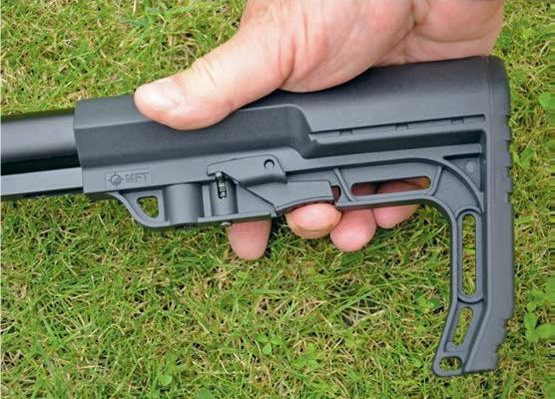
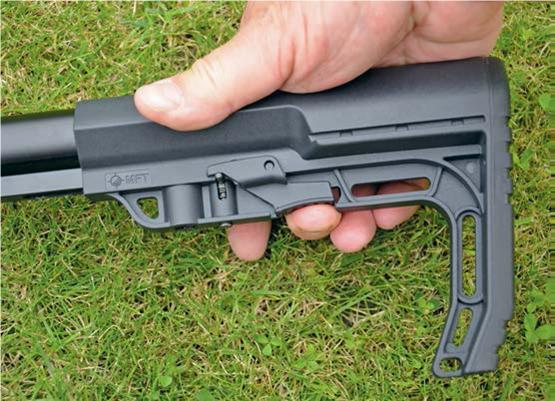
Stock wise, we’re talking tactical, and the aluminium front chassis sports a mini forend complete with Picatinny rail. The composite, drop-down AK pistol grip is surprisingly comfortable, and a small recessed catch in the base reveals a hollow void, for small accessories such as the single-shot tray to be stashed (padded up to avoid any rattles). The grip is AR compatible, as is the stock buffer tube, and it’s this line of thinking that keeps Brocock in tune with an increasing number of shooters that appreciate the option to adapt and improve their purchase with aftermarket components further down the line. In fact, the rear stock moulding is by MFT (Mission First Tactical), which is unashamedly militaristic, but again practicality is the driving force.
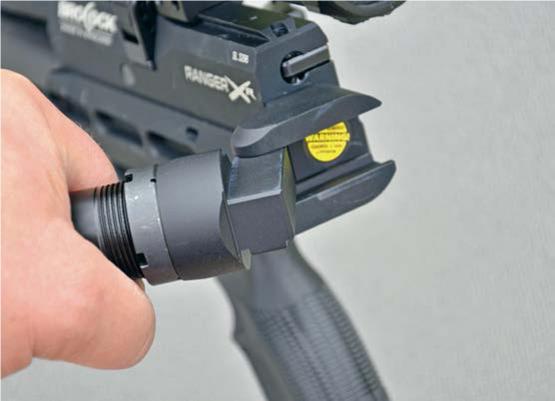
Look to the Ranger’s rear section and that entire moulded composite assembly is on a sprung slide. Just depress the button on the underside and slide it to any one of five stages, and the length of pull can be set to suit. However, the real ace up the Ranger’s sleeve is, of course, that folding stock format. OK, Brocock has incorporated this major feature in a few of their recent models, but it’s the Ranger XR that takes the concept to its limit. Simply jolt up the entire rear stock assembly via the sprung joint, just to the rear of the receiver, and the stock then folds back and locks in place to the left side. On test, it proved irritatingly stiff to break free, but I suspect this would ease up a little in use.
Now consider this. Without a silencer, it is 27.3” long. Fold in the stock, and it reduces to an astonishing 15.5”. I’m not aware of anything else quite so portable, and for either shooting from a confined space or a pest control job that requires either inconspicuous arrival or rucksack stowage for the duration, the Ranger XR comes into its own.
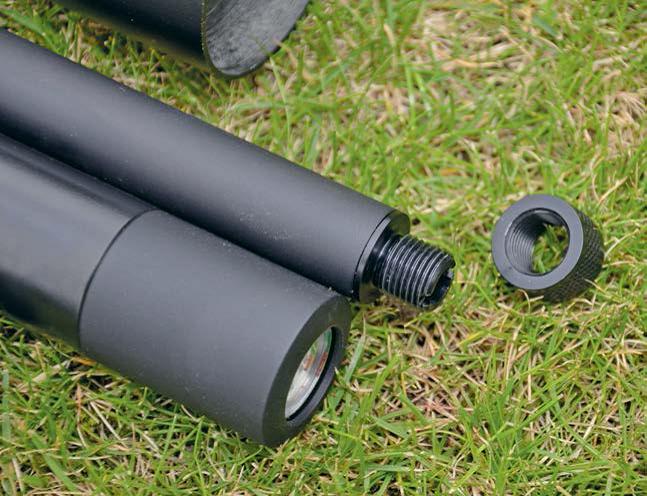
One key point to make is on a point of safety, and this concerns where the lead hand may fall in the aim. Look to the front of the rifle and you’ll notice that the barrel ends just 1/2” or so ahead of the cylinder. Get too enthusiastic in the grip, and you run the risk of digits in front of the barrel. It’s really easily solved, and the benefits are two-fold. Basically, with an ultra short barrel, the Ranger XR makes a fair old din, given the usual PCP crack as the air rapidly expands. Brocock mentions an adaptor for their 0dB Silencer, but in reality, it’s a standard 1/2” UNF thread, so many silencers are in the frame. Yes, you’ll extend the Ranger’s OD by a few inches but peace and tranquillity will be instantly restored. Oh, and you won’t need an appointment with your local A&E!!
While I’m at it, it goes without saying that with the pressure gauge at the front of the cylinder, viewing residual pressure can be another risky business, so care at all times here. Gauge on the underside please Brocock!
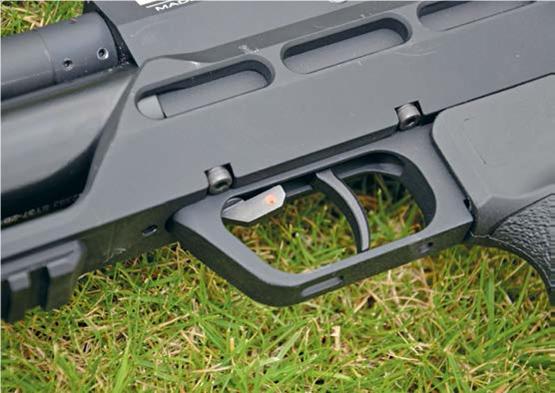
Charging the Ranger is via a push probe, and as usual, the adaptor comes supplied. Just twist the neat dust cover to expose the valve at the front, fully insert the probe, and charge to 200bar. The precision 2-stage trigger is adjustable and has a pleasantly shaped blade, plus a manual in-guard safety tab. I shot the rifle as set by the factory, as it tripped cleanly and with minimal fuss from the off, but for those who wish to tweak, the option is there.
As for the safety, it’s neat and works well on the fingertip, if and when required.
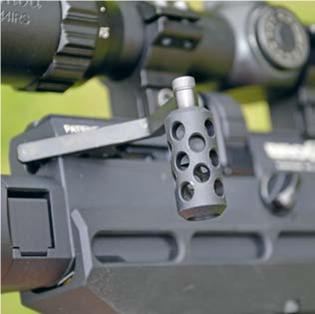
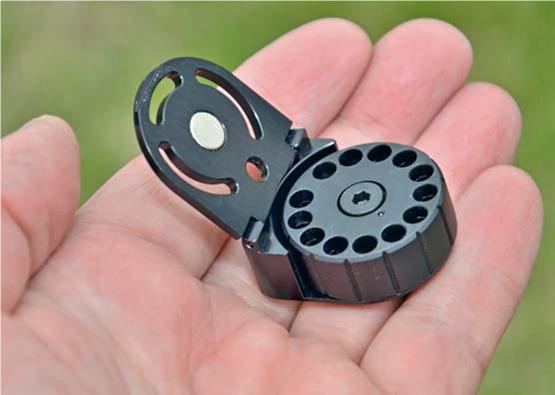
We get Brocock’s new style magazine here as mentioned, and this is an inevitable development, given the company’s association with the Daystate brand. The robust new all-metal design is self-indexing, and to fill it, first pull down the hinged front, rotate clockwise the inner drum, and holding against spring pressure, drop a pellet head first into the bottom chamber. This locks the drum. Now, fill each chamber and close the case. Pull back the side-lever and the mag then snaps into the mag well from the right side in a satisfying manner. There’s no play, it’s nice and snug. For those who favour one shot at a time, just slide in the single-shot tray - job done!
Working the side-lever is so natural with this rifle in the shoulder, due to its perfect positioning, and cocking effort is negligible. Cycling of the magazine on test also proved smooth and reliable throughout.
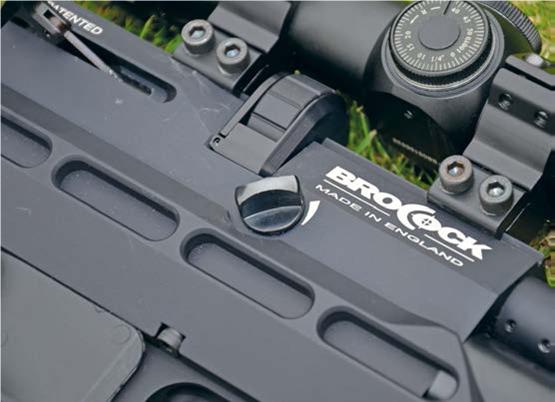
Look to the right-hand side of that sizeable receiver and you’ll notice the small power adjuster knob. It’s now a regular feature on Brocock models, and here, it’s a 3-stage operation, allowing the shooter to instantly switch through High (11.1ft/lbs on test), Medium (10 ft/lbs) and Low (7 ft/lbs). It works by restricting airflow in a Venturi style valve. In fact, given this model’s deliberately low shot count, courtesy of the scaled-down cylinder, the option to switch to low power for practice and informal shooting is invaluable; upping shot count at the click of a button. In short, it’s a brilliant feature.
The airgun comes fitted with a HUMA regulator, and Brocock’s tie-up with the Dutch company has been a good move, given the popularity of HUMA for aftermarket regs and fittings. Specified as a ‘regulated floating hammer system’, it all sounds impressive.
There’s also a FAC version. It features what Brocock term a ‘hammer dwell adjuster’that can be accessed along with the hammer spring, plus it’s also possible to adjust the Huma regulator. All features that are aimed at the more experienced enthusiast.
On test, using BSA Goldstar pellets, I clocked just under 28 shots within a total spread of 18 FPS, and with initial ragged groups of a little over 1/4” c-t-c at 30 yards, a sterner challenge was on the cards. Sub 1/2” over 40 yards was easy, and given the super light weight of the Ranger, and the less than favourable weather at the time, I was left impressed that this diminutive and highly capable PCP could be pushed further still.
As I get older, I’m finding that there is a compromise to be struck between lugging around a heavy but stable rifle/scope combo, and arriving at a lighter setup, that can still perform. The Ranger undeniably has its own raison d’être, with the folding stock and scaled-down action topping the list, yet for those who may fall into my ‘time to take it a bit easier’ club, this plucky little rifle could well be the solution.
Whether or not the Ranger XR is worth that not insignificant asking price is down to the individual, and many will think it’s a lot of fuss for 30 odd shots but they would be seriously missing the point in the process. For it’s that very combination of super scaled-down, carryanywhere format, bomb proof construction, and sheer ease of use of the modern PCP, that epitomizes what the Ranger XR is all about. And on that score, I’m sure it will go down a storm.
Thanks to Range & Country Shooting Supplies in Sleaford, Lincs for the kind loan of this rifle.
click on image to enlarge
click on image to enlarge
click on image to enlarge
click on image to enlarge
click on image to enlarge
click on image to enlarge
click on image to enlarge