Gun Reviews >
 Find a Dealer >
 Find a Club >
 Competitions >
 videos >
 Reader Survey >
Remington Express Synthetic
- Last updated: 27/02/2025



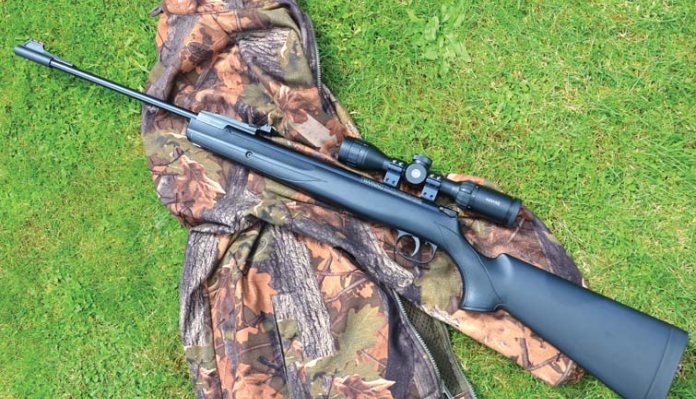
Take a close look at the rifle on test here, and the profile may look familiar, with the straight-line butt section and slimline fore-end. I’m not sure who exactly has copied who anymore, but suffice it to say that there are enough details and features designed in to differentiate this model from any similarly styled offerings from rivals. Welcome to the Remington Express Synthetic.
Scope included
Sold as a kit, this spring-piston break-barrel airgun comes complete with a 4x32 scope and twin ring mounts. This is great news for beginners, as it means they get a chance to try out a scope from the off. However, I would add the caveat that the kit scope is extremely basic, and better scopes are still available for very little money at the bargain end. My advice is to spend time learning the ropes with the open sights, then invest in better glassware if and when the time seems right.
So, fibre-optic open sights come fitted as standard, and there is a resettable automatic safety catch, a two-stage adjustable trigger, dovetail scope rails, and a sleek black synthetic stock. The finish is to a pretty high standard, with chemical bluing applied to the barrel and cylinder, and there’s a good lustre on show. Plastic components are used sparingly—the safety stud (not lever), foresight housing, trigger guard, and rear sight assembly—and that always helps the cause. As does the density of the synthetic sporter stock, which feels almost solid throughout, rather than hollow and tinny as some so often are.
Fibre optics?
So, how do the open sights shape up? Well, pretty good as it happens, with a spot-on sight picture combining two green rear elements and a small red fibre-optic front element. The rear sight is a neat design, and with properly numbered spring-loaded finger wheels for windage and elevation, it all works well. The foresight element, however, lacks protection.
Fitting the kit scope or any alternative is pretty easy, given the run of dovetail rails on the cylinder. Fancy a Weaver/Picatinny rail? Well, this is also available as an extra for just under £10, so further versatility awaits.
Firing cycle
The trigger gets a nice wide blade with ridges, similar to Weihrauch’s Rekord, which is praise indeed. It is not exactly in the same league for refined feel and range of adjustment, but wholly acceptable for this grade of gun, and well above average.
A big part of the attraction of using a break-barrel springer is the grab-and-go aspect, with simplicity being the byword for a fun and relaxing shooting session. In the case of the Remington, the barrel lock-up proved tight around the breech on my test rifle, so a jolt across the knee to initially break the barrel proved the best approach. This will probably ease with use, and thereafter, the cocking stroke proved very easy and fairly smooth too, which all adds to the pleasure of shooting this rifle. You can hear some spring ‘graunch’ during the cocking process, but I’m nitpicking. Just be careful of the exposed fibre-optic foresight when cocking the barrel. It’s more a case of getting into a routine of grabbing the barrel just behind the foresight assembly, and then all should be well.
On test, when the action was cocked, the safety catch didn’t always automatically set; but unusually, the break-barrel action can be de-cocked here. For those unfamiliar with this process, it’s a matter of keeping a firm grip on the barrel, then pulling the trigger whilst controlling the spring pressure, and slowly allowing the barrel to move back up, returning to its un-cocked position. This style of rifle often comes with an internal bear-trap mechanism fitted, preventing the de-cocking action, so it’s quite nice to have the freedom here. In addition, the small lever fitted to the safety allows it to be reset by moving it back and down.
The firing cycle itself is nice and muted, with no spring resonance, which is evidence that a spring guide has been fitted and is doing its job. There’s still significant recoil, as to be expected, but nothing harsh.
In use
The stock configuration features a straight-line cheekpiece, and it does look trendy and sleek. It’s fine when shooting with the open sights, but opt to fit a scope, and the cheek is just a little low. This is a common issue with many basic springers, but it seems avoidable with a bit more consideration during the design stage. Just a fraction more beefiness in the cheek area needn’t add much weight, but hey. I have experimented before with cheekpiece padding kits, which are available for around the £30 mark. These consist of a neoprene outer skin that pulls over the butt section, then one of three different-sized pieces of moulded foam can then be slid into place under the outer skin. With this extra support to the face, handling can feel transformed—and so it did here.
The underside features an articulated cocking linkage, resulting in a shorter cut-out under the fore-end, which enhances both rigidity and the rifle’s solid feel.
The performance wasn’t breathtaking, with groups measuring around 1.25” (centre-to-centre) over 30 yards, but bear in mind this is a budget rifle, and barrels are likely to vary from example to example in this price range. Over the chronograph, a 10-shot string showed a 20fps spread, which is hard to fault, and with average energy from a variety of ammunition around the 10.3ft/lbs mark, there’s clearly plenty of power on tap for general-purpose fun shooting—the sector of the market this model is aimed at, after all.
Verdict
Don’t expect too much, and you’ll be pleasantly surprised by this appealing Remington. Basic but robust.
Thanks to Range & Country gun shop in Sleaford—the only Premier Daystate dealer in Lincolnshire—for the kind loan of this rifle.

click on image to enlarge

click on image to enlarge

click on image to enlarge

click on image to enlarge

click on image to enlarge

click on image to enlarge