Gun Reviews >
 Find a Dealer >
 Find a Club >
 Competitions >
 videos >
 Reader Survey >
STEYR ARMS SCOUT II
- By Chris Parkin
- Last updated: 11/11/2024




The Steyr Scout was always a very interesting concept for a single rifle to go anywhere, do anything, and capitalise on modern design, materials, and styling from the 90s. The Scout II has not really varied much but has caught up in a couple of key areas, delivering a rifle that really is a simple, integrated package.
What’s the concept?
The concept is the rifle needs to be short, capable, accurate, tough, durable and have handling character as well as sighting solutions for all scenarios. Starting out, the cold hammer forged barrel on this example is 19” (485mm) long, which for a hunting rifle in .223 or .308, gives you all the stopping power you need and delightful handling characteristics. Shorter barrels are a relatively new concept compared to the original Scout, which appeared with a 24” tube, which was the norm. This barrel is fluted to save weight and has a capped ½”x28 muzzle thread.
The barrel disappears into the fore-end and is floated within the synthetic lower and full-length aluminium upper cover, which now carries a Picatinny rail, not the Weaver rail found on the original.
Aluminium bedding block
The polymer tip ahead of the rail holds a flip-up sight blade, and the very rear offers a ghost ring companion that doesn’t interfere with scope mounting. If you use QD Picatinny rings, you will have no issues swapping back and forth. Although, in fairness, does anyone use open sights on a modern hunting rifle these days? They are a backup and work well with the unstoppable, go-anywhere rifle ethos. They do align nicely, and you get intuitive pointability from the handy rifle. The barrelled action is anchored in an aluminium chassis to a bedding block within the polymer outer, so everything feels totally solid as well as rattle and flex-free.
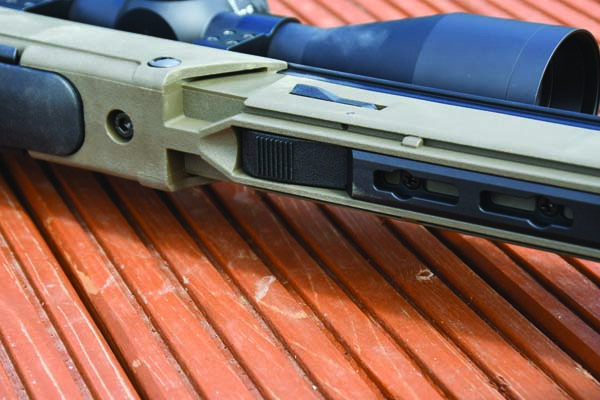
Bolt release
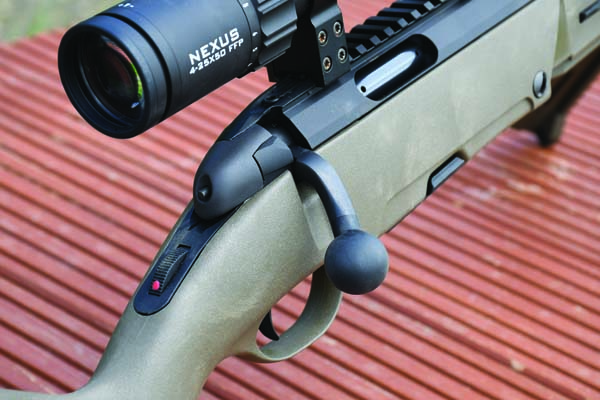
The bolt shows four internal locking lugs and is a push-feed unit with a 70 degree lift. The overall bolt travel is 93mm, so the action is perfectly scaled for the cartridges offered, without excessive cycling distance. The ejection port is also oval and similarly scaled, just large enough for the .223 cartridge.
The very tip of the fore-end upper and lower are polymer, but the barrel shroud has ventilation groves below the Picatinny rail. The rifle’s looks are fully integrated and sleek, and it swoops down at the rear into the bolt shroud, which shows a tactile cocked action indicator on its rear face. The right-side bolt handle is approximately 65mm long, showing a 24mm ball.
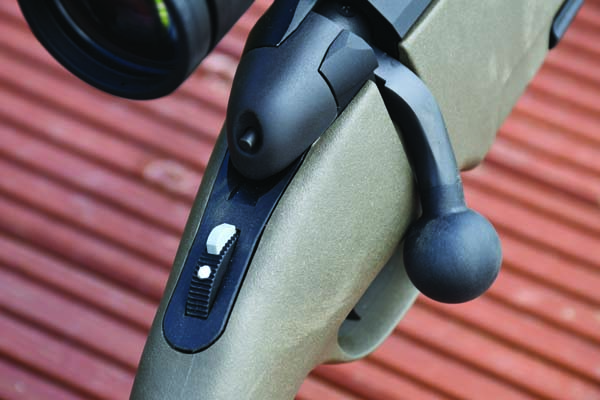
Steyr has an interesting concept whereby their tang-mounted, three-position roller safety gives forward for fire, middle for safe with bolt operation, and rear for safe with bolt lock, with a small blade arising from the dial. There are red and white markers but with the roller all the way rearward and the blade up, the bolt handle itself will push further down and close right into the side of the stock, minimising bulk when carried. As soon as you push the safety roller forward, the bolt handle springs up and enables fast, smooth action cycling, which I found fundamentally difficult to even deliberately jam. Rolling the safety rearwards with the bolt already open enables bolt extraction.
Green, black or brown
The polymer stock is available in three colours, and I chose green. The trigger guard is incorporated as part of the moulding, before the open radius, slim grip flows out to the rear buttstock. The comb is quite low, although I think an adjustable unit is available as an accessory if you want to complicate the rifle. There is a 343mm/13.5” length of pull, with a supplied spacer increasing the overall length to just over the 1000mm target the Scout originally aimed for. The rifle incorporates sling mounts that require Steyr’s own QD swivels. These are positioned on both sides of the rear bag rider, both sides ahead of the magazine, and there is a single one on the fore-end’s underside, ahead of the M-LOK rail. The overall stock finish is stippled, and it remains grippy when wet.
All that you need
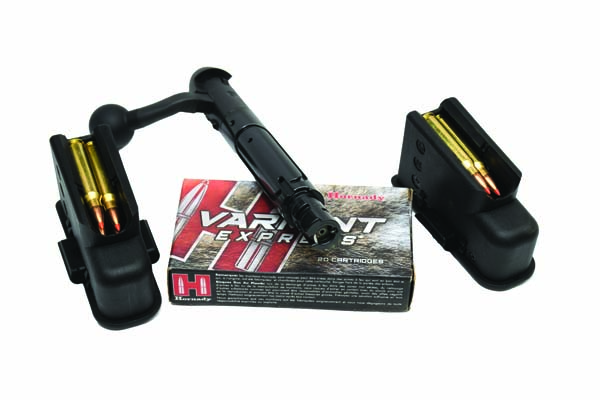
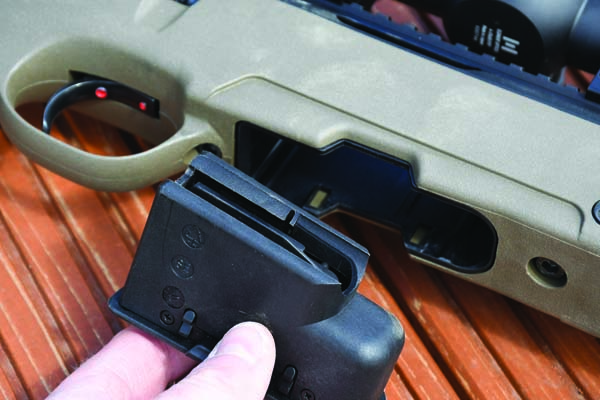
Another interesting feature of the Scout concept is the presence of two magazines. One magazine is located under the receiver as expected, while the other is clipped under the buttstock. This setup gives the rifle an overall capacity of 5+1 in the main magazine, plus an additional five rounds in the magazine stored in the buttstock. The mags use twin side catches for easy release and replacement. They load from the top into two columns, which is a less common but attractive feature for many bolt-action .223s that don’t use AR-derived magazines. An interesting detail is the butt’s mag well has a sprung follower inside to prevent any spare rounds from rattling during transit. Great!
Integral bipod
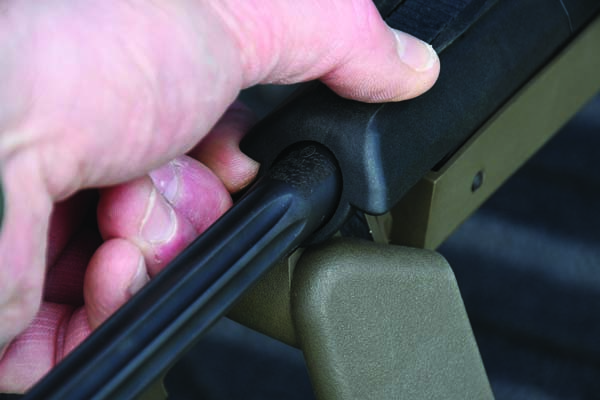
The final and perhaps most characteristic feature of the Scout is that there is a button on the underside of the fore-end that allows twin bipod legs to fold open. These are 11” long and also offer a cant facility for uneven surfaces. They are a little long for bench shooting but ideal for hunting when you just need that height to spring into a prone shot position and clear the foliage for longer, precise shots.
Picatinny is not Weaver
Picatinny makes life simple and there is plenty of it for day scopes or any electronic night vision/thermal options. Zeroing offered no challenges whatsoever and the thermally stable barrel maintained significantly better than MOA capability, from the first shot to the last. I have never had a bad Steyr barrel. The handling is slick, and I liked the fact you can have +1 in the chamber if necessary, yet even better was the fact that a single cartridge dropped through the ejection port would feed smoothly straight to the chamber. Magazine feed, firing, and ejection were all faultless, and I liked the shorter than 90 degree bolt throw.
Details
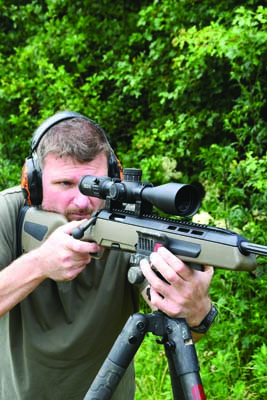
It’s nearly impossible to capture the intricacies of the design. The fore-end maintains a stiff free float, and the barrel is wrapped with millimetric precision, preventing any flex and intermittent contact from any shooting position. I used the rifle clamped in a tripod and it felt stable.
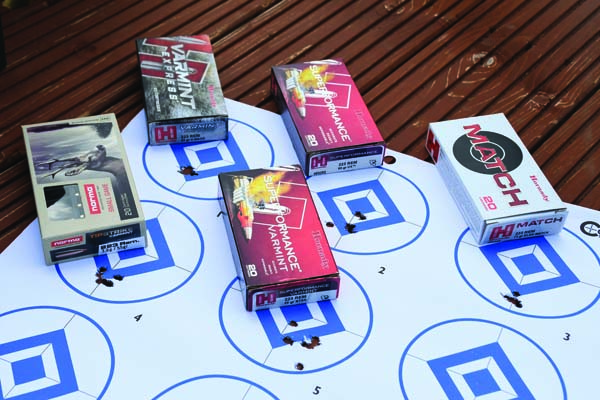
Primary extraction of fired cases was good, and it is worth noting the firing pin strike was a little stronger than many. I have one batch of hard-primed ammo that will not go off in weaker sprung rifles, but the Scout initiated them all. No barrel twist rate is specified but it stabilised 73gr match bullets without problems. The 55gr V-Max are a foxing delight and suit this gun perfectly, with sub-half MOA precision and close to 3000fps from a notably short barrel. (See Ammo Table).
Own the night
I didn’t happen to have a moderator to fit the rifle, but the noise and recoil are low. Importantly, the balance point is directly under the magazine, although this may change depending on your chosen optic. For night shooting, I find that many guns either appeal to me because of their ease of use, or fail in that aspect. I particularly appreciate the additional Steyr magazine, but more importantly, I value the direct-to-chamber feed in a backup situation. As a hunting tool, it really does the job to perfection, with or without the legs folded out. The legs have deep grooves moulded as part of their form, and when up, create a hand-filling and easily gripped fore-end with a flat base.
Conclusion
When the Scout concept appeared, it was innovative, and the latest version keeps that edge in the current market. It’s a fundamentally very well-designed rifle with superb manufacturing standards and an excellent heat-stable barrel that prints very small groups. The magazines work well and the trigger is consistent, although it might have been even nicer if not threadlocked, preventing me from tuning it slightly. The recoil from a .223 is minuscule anyway but this is a lovely rifle to use and shoot, with delightfully smooth bolt transit and a quiet stock. The rifle has character without appearing aloof or out of step with its peers, and the looks, which were revolutionary before, still appear fresh now. I like the Scout, it’s quirky for very good reasons.
click on image to enlarge

click on image to enlarge
click on image to enlarge
click on image to enlarge
click on image to enlarge
click on image to enlarge
click on image to enlarge

click on image to enlarge
click on image to enlarge
click on image to enlarge