Gun Reviews >
 Find a Dealer >
 Find a Club >
 Competitions >
 videos >
 Reader Survey >
Steyr SSG M1
- By Chris Parkin
- Last updated: 26/09/2022




Steyr’s SSG M1 has been officially tested in detail by armed forces to assess its functionality and capability in accordance with their needs, so who am I to begin critique? Also, how does all that testing apply to the civilian world?
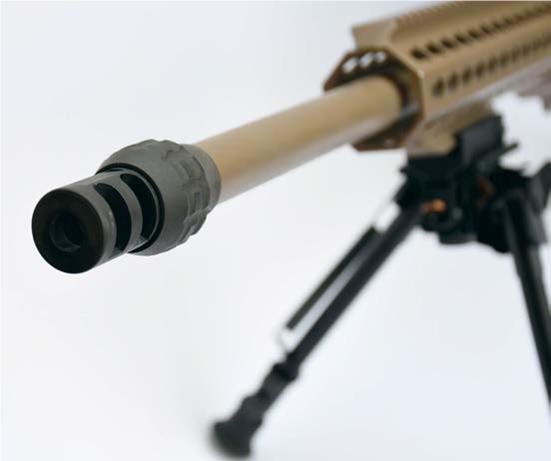
The barrel shows a 20mm diameter and is hammer-forged. It is Cerakoted flat dark earth like the aluminium stock and shows an external barley twist. Plus, there is a laterally ported muzzle brake capable of accepting an over-fit moderator at the tip.
The barrel is also interchangeable on this rifle as part of the gun’s multi role military capability, up to a .338 Lapua Magnum. A 6.5 Creedmoor is available on the same bolt face as this .308 too. The barrel length on the test rifle is 25” but you can go for a shorter 20” if you want. However, the .338 tube would measure 27” to make the most of the cartridge’s capabilities. A detailed manual is provided along with tools in the supplied hard case.
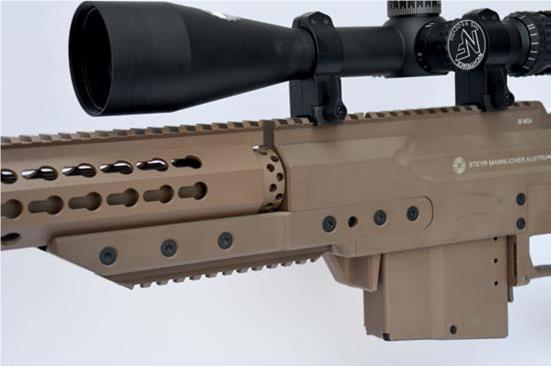
There is an octangular, fully-freefloating forend that allows the movement of cooling airflow. Plus, there are 104 Keyslot accessory points and a 30 MOA inclined Picatinny rail aligned with the action for scope/ accessory mounting. I used a short Picatinny add-on rail underneath for a Harris bipod, but the choice is yours for whatever support system suits you.
The magazine well holds a twin column 10-round aluminium unit with a polymer follower that can be top loaded in or out of the rifle. Also, single rounds will feed directly into the chamber if placed into the ejection port for a backup shot. Holes in the magazine walls allow you to see the remaining ammunition content.
The mag release lever sits on the front of the trigger guard and drops the mag cleanly into your waiting palm, while loaded or when empty. There is plentiful space in the trigger guard for a gloved finger and the blade offers 2-stage operation. It is adjustable for position and breaking weight. I weighed it as supplied at 1500-grams and steered away from the thread-locked adjusters.
A hinged dust cover clips over the ejection port to prevent debris from entering the action, and it automatically springs open when the bolt is cycled. There is also a case deflector at the rear of the ejection port.
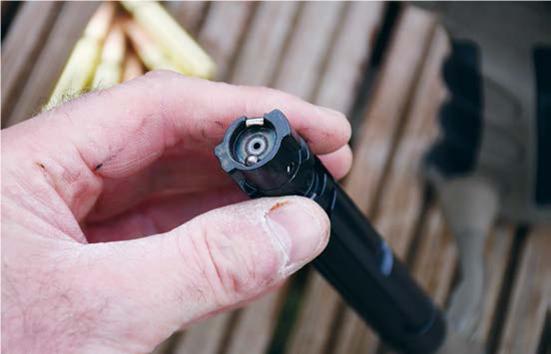
Steyr’s bolt has four lugs in two opposing pairs. They are slim, so you get a 60º lift (approx) on the handle (where you may have expected to get a 90º) and lift force is as light as a twin lugged bolt too. There’s a push feed bolt face with a single extractor claw and plunger ejector that proved 100% reliable throughout this trial. The bolt shaft is 20.7mm in diameter, with a 112mm stroke. This is longer than a .308 cartridge needs but is required for the longer .338 option. The handle is 60mm long and conically tipped with a 22mm head for grip in operation. Although bolt operation was physically light and fast, you could feel the bolt’s underside rubbing on the polymer magazine follower slightly.
Steyr’s characteristic tang mounted roller safety catch enables forward for FIRE, middle for SAFE and the rear position locks the bolt. It departs from the regular format here, as it also has wings on both sides of the action, allowing mechanical operation and perhaps also enabling greater multi-positional visibility of the gun’s status. Regardless, all works perfectly, and it also controls bolt removal when required.
The final and most subtle Steyr trick is that the bolt handle can be locked in close to the stock when ‘safe’, so that it does not protrude as much when transported. It then pops back up as soon as you set to fire for normal operation.
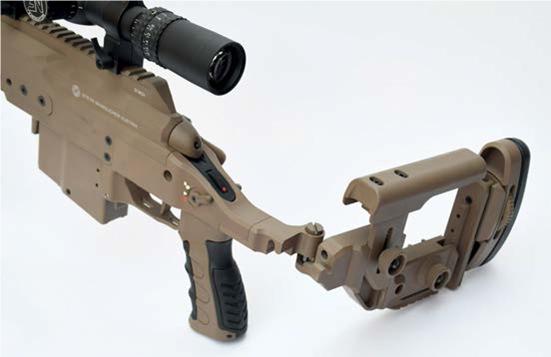
The underslung AR-15 type grip and ergonomics are fundamentally familiar to military users and here, supplied interchangeable panels on the front and rear can alter it in size and shape for differing hands. The reach to the trigger blade is adjustable and measured from the throat it was mid-range at 76mm.
There are slots in the trigger guard’s underside for Allen key access to the trigger adjusters if you want to twiddle. Adjustment is covered in the manual if you want to remove the thread-lock.
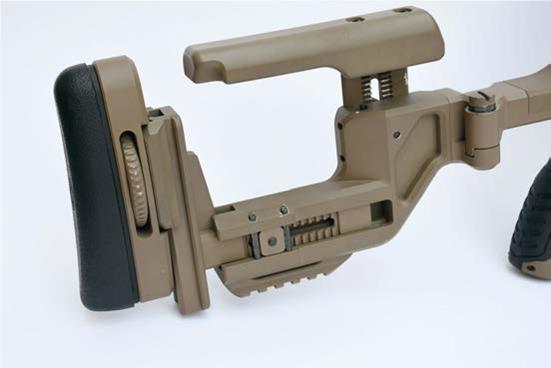
Overall, the stock is fully user adjustable. The cheekpiece allows 38mm of vertical movement and has teeth for additional security when clamped with the thumbscrew adjusters, which when loosened, are sprung to enable untoothed motion.
The comb adjusts laterally with a Torx driver to enable perfect head alignment behind the optic. It is slender and engages under the cheekbone without pressure on the jawbone, a factor I’m a huge fan of as it lessens resonance transfer to the skull while helping to keep your eyes level.
The length of pull adjusts from 355-400mm using a similar sprung locking system for assured consistency without any rattles. There’s an underside Picatinny rail beneath the butt for a monopod or soft rear bag but no specific hand stop. The recoil pad is firm rubber and adjustable for angle and vertical position, with 65mm of travel top to bottom.
There is a hinge mechanism allowing the stock to fold with a strongly sprung latch that locks the gun securely straight or folded. The latter position shrouds the bolt handle for protection and makes storage and transportation of this large, heavy rifle much easier. It also makes bolt removal and cleaning a lot simpler as there is no need to move the cheekpiece!
Unsurprisingly, and make no mistake, this is a serious rifle that has been arduously tested to high standards by those far more at risk than I will ever be. The gun shoots with precision and accuracy. I had to use it alongside an Accuracy International AXMC for a ‘head-to-head’, so once the same ammo was confirmed worthy in both rifles, I used it for all further side-by-side comparisons.
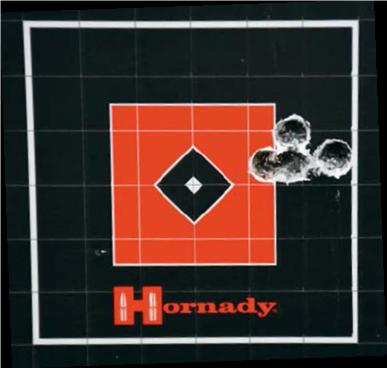
Hornady’s 168-grain ELD-M performed flawlessly and maintained a high standard from a cold or hot barrel. As long as I was paying serious attention and watching the wind changes, the SSG could stay sub 20mm for ten rounds at 100m, until cooking hot in 30-degree heat.
While shooting steel at longer ranges, the gun was just as accurate and consistent as proven on paper, but I was now more focused on tracking bullet trace visually through the optics as well as reload speed from supported positions, assessing how bolt operation interacted with maintained aiming, as well as overall firing comfort.
A brake on a .308 this heavy means there is no real ‘recoil’ of a possibly painful nature, and I’m pleased to say the gun is not only a linear force pussycat but also maintains sight of the target and trace easily through the scope. The brake directs sound away from the shooter and it was noticeably well behaved, with bystanders commenting on it too.
The stock’s adjustability allowed superb positional comfort from seated, supported standing and prone positions, but in the current climate where PRS is the hot competition, this gun won’t fit the bill. It’s a little too heavy, with a bulky forend that’s not so easy to weave around or between narrow barricade cutouts. However, when you have to maintain bipod position on poor surfaces, it’s all stiff enough to offer a good perception of bipod loading pressure. It’s also not simple to customise the balance point without adding additional mass to overcome the already heavy and durable architecture that is designed for warzones.
This is an expensive gun, and it impresses functionally without doubt, but it needs to attract buyers who specifically like the design style and reputation too. The direct competition is £2000 cheaper and although outright very similar (they are both designed around the same requirements and test procedures), the one factor that held the Steyr back is the trigger, which although reliable, is not as crisp as I would have expected. Steyr’s barrels are very good and have proven their worth to me on multiple occasions in sporting rifles too. So, the rarity of the SSG M1 must appeal to any buyer just as much as its assured capability and the fact I really can’t find fault with the gun. Personally, as a civilian not sharing gear, I would immediately remove the thread-lock and adjust the trigger.

click on image to enlarge

click on image to enlarge
click on image to enlarge
click on image to enlarge
click on image to enlarge

click on image to enlarge
click on image to enlarge
click on image to enlarge
click on image to enlarge