 Gun Reviews >
 Find a Dealer >
 Find a Club >
 Competitions >
 videos >
 Reader Survey >
Fort George
- Last updated: 25/01/2022




The countries of Canada and the United States of America share a border extending almost 4,000 miles, across which trade and tourism traffic passes peacefully each day. However, during the late 18th century and early 19th century things were different, with much of the border being unexplored wilderness. It was also a region of tension, with Britain controlling Canada as a Crown Colony, and America, harbouring antipathy towards the country from which it had only recently gained its independence.
In 1797, Britain seized the initiative and built a series of defences under the direction of the Royal Engineers to secure strategic points along the Canadian border. One such fortification was called Fort George in honour of King George III. It was built using stone and earth banked up to form ramps topped by a wooden palisade using trees in the stockade style. The method was cheap and meant that if the defences were damaged in battle, then they could be repaired quickly in the same manner. Fort George was completed in 1799 and is sited on the western bank at the mouth of the Niagara River, where it opens into Lake Ontario.
Before this, the British army retained a garrison on the American side of the border where it held the site of Fort Niagara on the opposite bank of the Niagara River. This position was bought to an end by ‘Jay’s Treaty’ of 1794, which led to the British handing over the position to the Americans in 1796. Fort Niagara had originally been built by the French in 1678, which the British had captured in 1759. The location had been a base for British troops during the American War of Independence, which they had managed to hold on to following the end of the war in 1783, but Jay’s Treaty meant the British had to withdraw back across to the Canadian side of the Niagara River, where defences were built along the border to ensure security.
The situation between America and Britain was always tense at this point of the border with incidents, such as the firing on HMS Little Belt by the USS President on 16 May 1811. There were calls from some quarters that America should declare war against Britain and attack Canada. The ‘hawks’ finally got their wish on 19 June 1812, when the country declared war against Britain. This was justified by arguing that it was to keep open the sea lanes for American free trade.
By now building work to improve Fort George was completed and the fortifications included more earthwork outer defences, palisades of logs, log-built buildings such as storerooms, a stone-built powder store, log blockhouses for the local militia force and to serve as the headquarters for Major General Sir Isaac Brock.
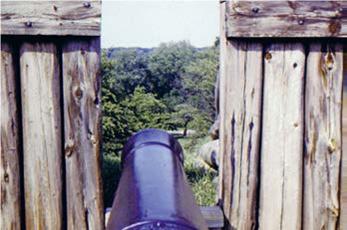
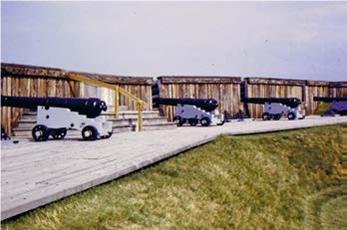
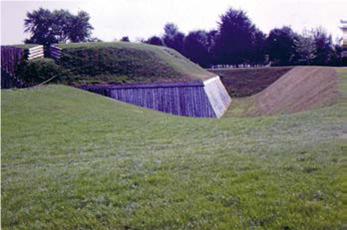
The defences at Fort George were laid out in a rectangular pattern, with a single access point to the site. Each of the four corners was designed as bastions and elevated to allow for artillery to be sited and also to provide infantry with greater vantage against an advancing enemy. At either end, a structure known as a ravelin, an arrowhead-shaped structure with the pointed end facing out towards an attacker with the broad base facing towards the defenders, was constructed forward of and separate from the defensive walls. The purpose of the ravelin was to serve to split an attacking force and by breaking it up, allow the defenders to deal with them more easily. On each of the long sides a bastion built into the walls provided further platforms for artillery, and together with the four corner bastions gave the fort six such positions. In front of the palisade, a dry ditch was dug all the way around the site in the manner of a moat, to present the fort as a formidable challenge to any attacker.
When Brigadier-General John Vincent was appointed to command Fort George in 1813, the garrison comprised 1,000 regular troops, 300 militia and 50 native tribesmen, but only five pieces of artillery. Finally, on 25 May 1813, the long-expected attack began when American artillery from Fort Niagara opened fire. Two days later, Major General Henry Dearborn landed a force of 4,000 men on the shores of Lake Ontario to the west and to the rear of Fort George. The attackers were supported by a number of gunboats, including the corvette ‘Madison’, armed with 14, 18-pounder guns and 16 carronades firing 32-pound shot, and the brig of war ‘Oneida’, armed with 16 carronades firing 24-pound shot. The garrison at Fort George fought well, but General Vincent, knowing he was faced by a superior force, ordered a withdrawal to Queenston. The guns were spiked, by hammering nails into the powder vents, but only one of the powder magazines was successfully destroyed. The fighting had cost the garrison 52 men killed, 306 wounded and 276 taken prisoner and most of the fort’s buildings destroyed. The Americans, with losses of only 40 killed and 113 wounded, took possession of the fort immediately.
After six months of occupancy, the garrison had been reduced to a caretaking force of militia troops commanded by Brigadier General George McClure. When he saw a large force of British troops approaching, he knew he would not be able to defend the site and ordered a withdrawal back across the Niagara River. On entry, the British found it still devastated from earlier fighting, so repairs began. This work was halted a year later when the war ended on 24 December 1814 with the Treaty of Ghent. The British kept a small garrison at Fort George, before abandoning the site in 1820. The site was used during both world wars as a training ground for troops, but nothing permanent. In the 1960s it was finally vacated, bringing to an end to 160 years of association with the military.
Today, it’s a Canadian national monument open to visitors. It hosts special events depicting the period of 1812 that are presented by groups such as the 41st Regiment of Foot, which gives displays of musket fire, drill and living history, to show civilian and military life of the time. The buildings have been replaced and the only original one on-site is the stonebuilt, powder store. It’s well worth a visit during a trip to the area and will satisfy military enthusiasts. Visits www.pc.gc.ca/fortgeorge for details.

click on image to enlarge
click on image to enlarge
click on image to enlarge

click on image to enlarge
click on image to enlarge


