 Gun Reviews >
 Find a Dealer >
 Find a Club >
 Competitions >
 videos >
 Reader Survey >
Reloading: Energy Delivery
- By Pete Moore
- Last updated: 22/11/2016




The bullet (projectile) is your energy delivery system. It takes the energy generated during firing and delivers most of it to the target. At least, it should. By and large the process is potentially efficient. During the flight the bullet has to overcome some forcement in the barrel, carve its way through the stodgy air and resist the persistent attraction of gravity. What’s left is available to be transferred to the target. If you’re paper punching then up to 99% of that residual energy is dissipated as deformation work and heat in the sand of the stop butt. That energy overkill is necessary to ensure the most important ingredient of target shooting, consistent accuracy. However, if you’re pest controlling or hunting and the pill remains in the target then all of the residual energy has been delivered. Job done, well probably?
SPECIFIED LIMITS
For applications beyond target shooting the criteria for bullet design and minimum energy are often enshrined in National or International Law. By way of example, an International convention bans the use of the best target bullet shape, the wad-cutter, and also the best hunting bullets against human targets. Whilst best known for the banning of the ‘dumdum’, the military convention goes much further, banning any design which could be construed as ‘expanding’. For hunting use the rules are generally set at a National level and reflect the nature of the game to be taken. In Case Histories we’ve recently discussed the limits set in various African countries for use on the Big Five. Closer to home we have minimum limits set for the taking of deer. These parameters ensure the reasonable outcome is a clean kill. In a civilised society it is also accepted that pests should also be taken as cleanly as possible with a range of ‘accepted’ calibres for each species.
MATERIAL WORKS
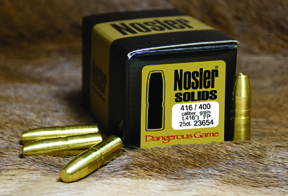
Four primary factors contribute to optimising the efficiency of energy delivery when hunting. The construction and shape of the bullet, its velocity and the ‘construction’ of the target. Solids are generally made from either lead/lead alloys or copper/copper alloys. Simple composite bullets generally comprise a lead or lead alloy core with a sheath of copper alloy, usually gilding metal. At the most basic level this sheath is in the form of a copper wash which offers limited structural performance, merely acting as an anti-fouling agent.
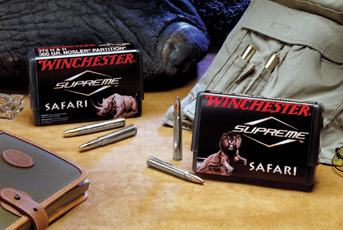
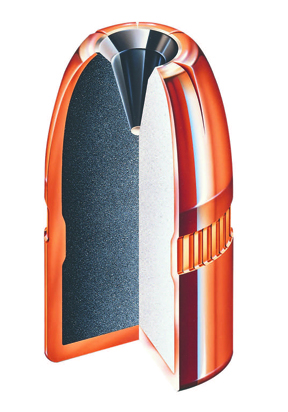
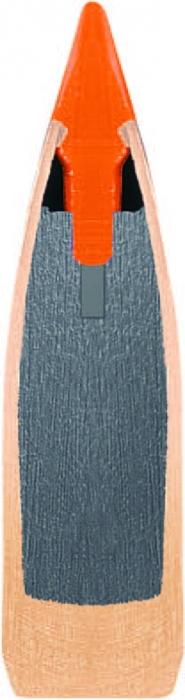
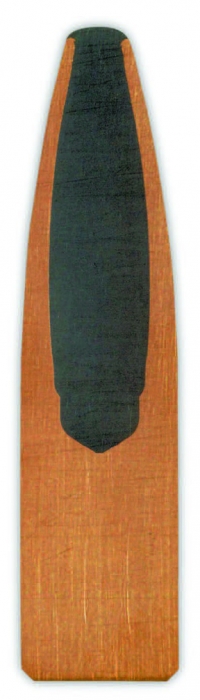
More robust designs are described as jacketed. Here the gilding metal is in the form of a shaped cup of specific wall thickness. This may be of a completely closed design, or fitted to expose the core metal at the base or tip. For increased structural integrity some advanced designs use a cup with a thickened base. Partition designs are next. These employ a range of sophisticated assembly processes in which the wall thickness of the jacket varies and the core is held captive in two or more ‘partitioned’ segments within. Even greater strength is offered by designs which employ a ribbed interior surface within the partition jacket – thereby obviating the risk of the core failing to adopt the spin imparted to the projectile on firing.
CRIMP IT
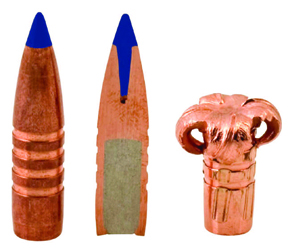
Many composite bullets employ one or more cannelures which serve a dual role. They not only improve the bond to the core but aid the cartridge assembly process by allowing a positive location for the case neck crimp.
Multi-composition bullets are a bit of a speciality, mostly derived from military applications. In addition to the main lead core these can include a tungsten or steel penetrator in the front partition.
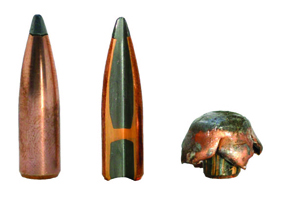
The transfer of energy from the projectile to the target is a complicated process that can be simplified by the use of the appropriate shape travelling at an appropriate speed. As an example, a 220-grain Partition JSP in .308 Win at 1900 FPS would have enough energy for use on Roe but may be too robust and fail to give adequate expansion. Whereas a 150-grain BT Spitz SP at 2600 FPS would expand nicely.
PLETHORA OF SHAPES
The plethora of shapes designed for hunting Worldwide can be boiled down to three, plus the addition (or not) of a chamfered base known as a boat tail (BT). Simplest is the round nose (RN). Whilst a fully jacketed RN would not be deemed as expanding for deer purposes, a sufficiently rugged version could be approved for the much tougher hide and construction of a Cape Buffalo! However, if the tip of the RN has an exposed lead core it would be designated an RN SP (Soft Point), in which case it may be considered expanding in the UK.
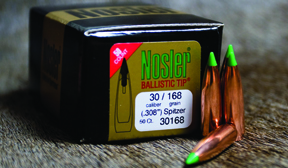
Next comes the Spitzer (Spitz) design where the tip is formed to a virtual point. If the point is part of the jacket it may not be considered as expanding, whereas a lead SP would be OK. Plastic-tipped versions such as the patented Nosler Ballistic Tip include a pointed plastic insert. This gives the double benefit of improving the ballistic coefficient as well as acting as a penetrator/tip expander upon impact. These tipped designs depending on, calibre size and build can be used on varmints and full sized game species.
Finally we have the hollow point (HP). In most instances the jacket is fitted over the base of the bullet and then rolled into a depression at the tip. Some manufacturers fit a jacket that is cut into petals where it is formed into the hollow, increasing the mushroom effect on impact. In general these have a much lower ballistic coefficient and should only be considered for pest control or use at reduced ranges.
IMPACT RESISTANCE
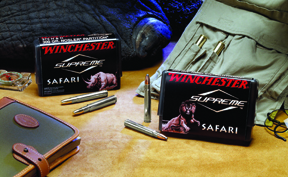
Projectile speed and the nature of the target are often related variables. A really robust bullet moving at significant speed may be necessary to penetrate the hide of an elephant or buffalo and then provide adequate internal expansion to kill the animal, whereas the same pill would simply pass clean through a smaller, thin skinned animal. Some of the manuals quote a range of animals for which each bullet design is most appropriate. Hybrid loading can sometimes extend the range of animals that can be taken with a single calibre. A typical example would be the use of downloaded .308 Win for fox.
click on image to enlarge
click on image to enlarge
click on image to enlarge
click on image to enlarge
click on image to enlarge
click on image to enlarge
click on image to enlarge
click on image to enlarge
click on image to enlarge
click on image to enlarge


