Gun Reviews >
 Find a Dealer >
 Find a Club >
 Competitions >
 videos >
 Reader Survey >
Lee Automatic Case Primer
- Last updated: 25/01/2022



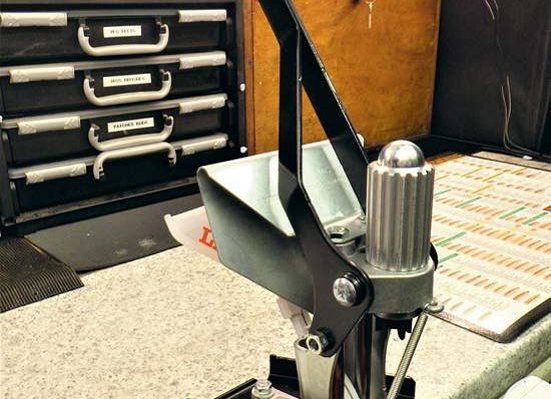
When it comes to priming tools there is certainly no lack of choice, with handheld, press mounted or bench mounted options. Now, Lee Precision has added a dedicated priming press to the mix.
The Automatic Case Primer (ACP) has some great features that you will not find on other priming tools and it makes priming very quick, safe and consistent. They have taken some existing priming principles, combined them with some completely new elements and put them all onto a dedicated priming station that you can mount in their bench plate system or directly fix to your workbench.
Primers are fed into the tool from the standard Lee folding primer tray, which is great for flipping the primers over and feeding them effectively. The tray is installed behind a very substantial ‘explosion shield’ which is reassuringly thick and consists of two layers of steel plate. Even if you have never had a tray of primers explode, it is good to have so much protection between you and them, just in case.
The primers then slide down the new primer trough where they are held until called for individually by operating the lever. A small projection on the side of the trough deliberately catches on the frame of the press each time you cycle the lever, to shake the primer tray and encourage them to keep flowing smoothly. Another very clever idea. You immediately notice that the bottom end of the primer trough looks ‘squashed’ by the spring that sits on it, and it just does not look right, but it is actually supposed to look like that and it does work, so do not try to fix it because it is not broken!
During testing, Lee Precision confirmed that the spring ‘squashing’ the end of the trough is what holds back the stream of primers and one is only released onto the primer insert after the lever is lowered and the spring pressure is temporarily lifted. The press worked well throughout testing, even when operated at speed, but how long the end of the trough will last, longterm remains to be seen. The ACP relies on the flexibility of the plastic to work and it is probably worth investing a couple of pounds in a spare trough, just in case it wears out.
Cases are fed from the left and the finger guide positions each one precisely over the primer. You can either put cases onto the press by hand one at a time or add a case feeder, sold separately, which will then drop cases into the guide and speed up the process considerably. The case inserter is also plastic but it works very well.
The cleverest part of this tool is that it does not require shell holders, so no repeatedly switching over for different calibres. Instead, there are just two priming inserts, one for large primers and one for small. Changing for primer size is the only time you would need to switch anything over. The ACP positions each case perfectly over the primer each and every time without the need for a shell holder to keep it in place.
As the lever is pulled down, a case is positioned over the priming insert and the breech lock prime die travels downwards and pushes it onto the primer. The priming insert is springloaded and as the main body is pushed down by the case head, the primer is left in an elevated position where it is seated into the primer pocket. Each time you cycle the lever a new case is introduced to the press and the previously primed case is pushed out of the way. It is actually a very simple process and as long as you fully raise and lower the lever, it works every time. Instead of the primer being lifted, like on other priming tools, it stays in position and the surrounding body of the insert is pushed down by the case, again, very clever stuff.
Pushing the case onto the primer, rather than driving a primer into the case, and the fact that the amount of travel on the primer insert is limited, results in primers that are seated perfectly every time, plus you cannot apply too much pressure and flatten the primers. All of the primers are seated flush with the face of the case-head and retain a nice curved edge, which is exactly what you are looking for. Even when cases are processed very quickly, the primers seat perfectly, with remarkable consistency.
This is a great tool, giving very consistent seating every time, which enables you to prime a lot of cases very quickly. Having a dedicated priming press attached to the reloading bench, and not needing numerous shell holders, is really handy and makes the process so much easier and more convenient. The materials used are what make the press work, rather than an attempt to reduce production costs, and although the trough looks odd, it does its job well. The ACP is well priced and it is good to be able to buy something that does not need loads of extras to be purchased before you can use it. Everything is there in the box to allow you to start priming cases straight away.
A case feeder does speed things up, but feeding them one at a time by hand works just fine and can actually be done pretty quickly once you get into a routine. This is definitely an item worth having and, so long as you follow the instructions, it is very easy to use.