Gun Reviews >
 Find a Dealer >
 Find a Club >
 Competitions >
 videos >
 Reader Survey >
Case Histories: 30-30 Winchester
- By Wheelwrite
- Last updated: 17/03/2017



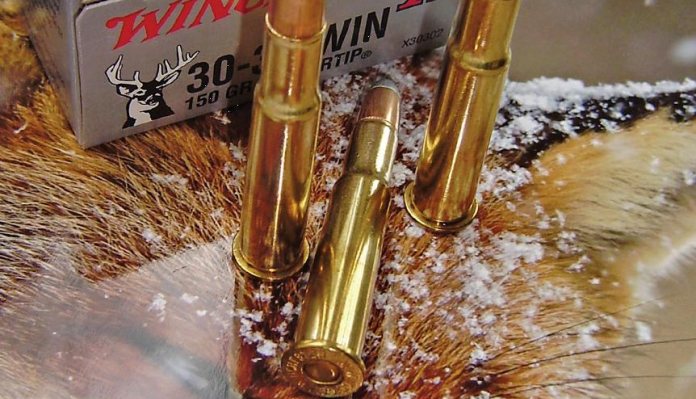
One of the best known calibres that most of us actually know very little about! It is generally accepted to be the first commercially manufactured ‘small’ calibre smokeless cartridge. The earlier Krag started life as a BP burner. As with several other Winchester designs, it gained its popular name from the Marlin Rifle Company who chambered their Model 1893 lever-action rifle for the design but steadfastly refused to include the name Winchester in the description. Hence the 1895 .30 Winchester Center Fire (.30 WCF) became much better known as the .30-30 or .30-30 Smokeless. The hyphenated nomenclature being a throwback to the black powder principle of naming the calibre and the charge in grains.
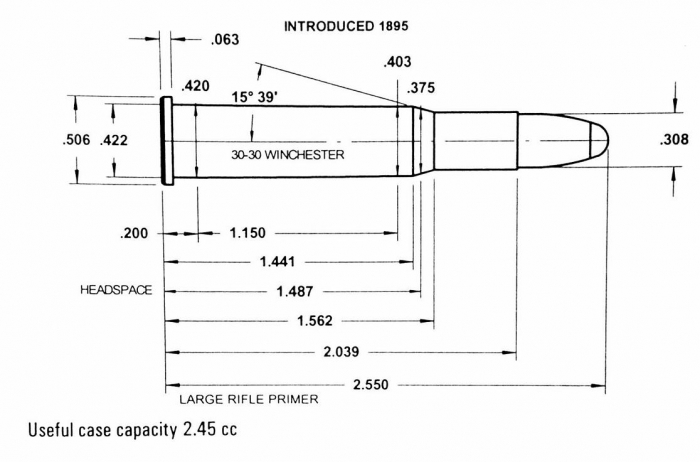
Introduced for their Model 1894 Lever Action, the .30-30 Win was an all-new, rimmed, bottle-neck, large rifle primed design. It featured a distinctive deep neck (not unlike the Krag) that housed a 160-grain, round-nosed, full metal jacket pill, a safe shape for use in a tube magazine. The shallow neck angle and deep neck limited the practical case capacity, restricting performance to a modest 2350 fps. However, this resulted in comfortably low recoil combined with enough grunt to take small and medium game, thereby ensuring its lasting popularity.
If you’re firing your .30-30 in a lever action, then it is advisable to full length resize the brass. Whilst this will reduce the number of working cycles it will ensure that the feeding qualities of the cartridge are maintained. Furthermore, you must remember to crimp the bullets in order to avoid set back under recoil. If you’re planning on using a bolt action or single-shot rifle then you can fire form and neck size the brass as normal but examine the throat length and test fit dummy rounds before reloading – especially when using very light or Spitzer bullet designs. One caveat; in tube magazines do not use pointed (spitzer-type) bullets, as it’s possible for a point to sit on a primer above and recoil might cause it to go off in the mag. Stick with round and flat-nosed for lever guns!
Unfired brass is available, as is a wide range of factory ammo for once fired assembly. Full-length die sets are listed by RCBS, Lee, Hornady and Redding. Load data is in almost every manual I own. Powder and bullet choice is large, remembering that you need cannelure bullets for use in the tube mag. As an added bonus, the low pressures mean that round-nosed lead bullets can be safely used in this cartridge, with Lee quoting data for weights ranging from 115 to 190-grains. Energy is not dissimilar to that of the .243 Win, with ballistics fit for medium range deer hunting.
Despite the modest pressures and recoil, case life is not that good. The original 19th century brass was extremely flimsy and whilst modern case makers have made it more robust, it still requires careful inspection, handling and use.
As it is eligible, I’m sure you could get it conditioned for deer; however you would need to consider your bullet design, the Speer 170-grain Flat Soft Point being a popular choice. Lever action fans would find it a bit lively for Cowboy Action Shooting but there are a number of classic comps that would make better use of its qualities. Lever-action rifles are fairly easy to find with second hand Winchesters and Marlins for under £400.
For value for money I rather like the Henry Repeating Rifle. At the other extreme you could be the proud owner of a Model 1894 Winchester Limited Edition Centennial for just under £2k. Amongst bolt action and single shot rifle designs the Savage Model 340 is a classic, as is the Thompson Center Contender, which is a switch barrel.

click on image to enlarge
click on image to enlarge