Gun Reviews >
 Find a Dealer >
 Find a Club >
 Competitions >
 videos >
 Reader Survey >
Reloading: How Long is Yours?
- By Wheelwrite
- Last updated: 06/12/2016



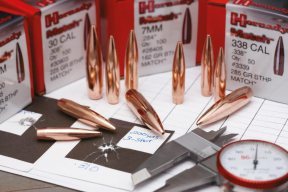
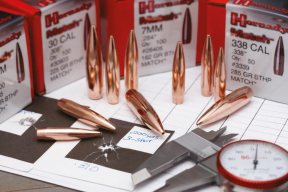
On to this month’s return to cartridge overall length (COL or COAL) and pressure… a potentially dangerous and often misunderstood relationship. We looked at it a year or so ago but it now seems to need further exploration, so here we go. Loading a cartridge to a specified overall length without reference to a number of other factors can be a recipe for disaster.
In extremis, the cartridge has to be short enough to fit in the mag or chamber and on the other hand, long enough to feed and avoid becoming a grenade. Using factory ammo as a dimensional guide is not advisable since the manufacturer has (or should have) designed the product to comply with CIP or SAAMI guidelines and then tuned these dimensions to make the cartridge function in the widest possible range of production rifles. Unless you pull a round in order to establish the exact length of the pill and therefore, the position of the base, its COL is pretty meaningless. The consequence of this compromise means that factory ammo is unlikely to offer optimum performance in any commercially manufactured rifle, but will (or should) always be safe.
The further we move the base of the bullet into the cartridge case, the smaller the working volume (air space) becomes. As we reduce this space, for a given volume of propellant, the loading density increases. The result will be increased case pressure for the same load. However, if we move the bullet forwards to the point where the ogive/ bullet bearing of the chambered round engraves the lands then again, pressure will increase. It’s therefore pretty obvious that for a given bullet diameter, the smaller the case capacity the greater the percentage effect of a given change in seating depth.
For example, let’s take a look at a couple of .30 cal cartridges, .30 Herret and .300 Weatherby Magnum. The useful case capacities are 1.97 and 6.40 cc’s respectively. Imagine an increase of 2 mm in the seating depth of the pill in each of these cartridges… an affective volumetric change of .096 cc’s. That represents a capacity reduction of almost 5% in the Herret and 1.5% in the monster Weatherby. Whilst they’re the extremes, it is of more relevance to note that it represents almost 3% in the popular .308 Win! Would you tolerate a 3% variation in the powder charge? I don’t think so.
Staying with .308 Win, we see that SAAMI quote a COL that ranges from 2.490” to 2.810”, that’s a HUGE range. Therein lies the point, COL is not an absolute. Within this range there is an optimum figure for a specific combination of rifle chamber and throat dimensions together with any individual bullet design.
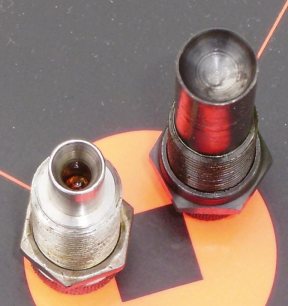
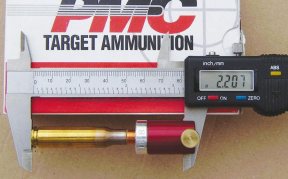
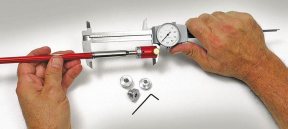
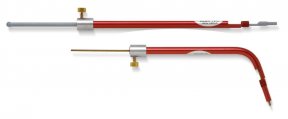
Measuring your rifle chamber is a simple process; there are a host of cheap tools from the likes of Sinclair and Hornady that get the job done. However, if you’ve only got one or two rifles, the cheaper option may be to construct chamber dummies. All we need is a batch of fire-formed (once fired are best), de-primed but not sized cases from the rifle to be measured. Check the fit of each of your preferred bullet designs in the neck and, if necessary, nip the re-sizer on the neck to ensure the bullet is a movable interference fit. Seat the bullet long, colour it with a marker pen or black with a candle and gently chamber it. Lock the bolt and then remove the round. Our proto dummy should have a broken witness mark around the ogive at the point where it has engraved the lands. Carefully place the round in the die and crimp it in place, either with the crimp tool or by starting the neck sizing process. Make sure that the bullet has not moved during the process. Using an engraver or maker pen, identify the dummy by adding the bullets makers: code number and style. Now carefully measure the overall length of this cartridge and enter all the details in your loading log. Repeat the process for each bullet design that you use, even if you only use those of the same weight and ‘design’ but from different manufacturers.
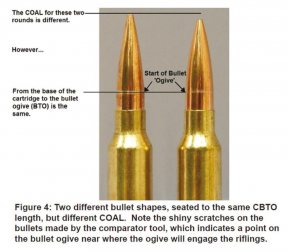
Why so fussy? Because, even with all other things equal, the bearing length and ogive profile can vary significantly; thereby changing the engraved length of the assembled cartridge. We can now establish a starting COL for each of our cartridge designs. For starters I usually reduce the dummy dimension by .010” and check the feeding qualities of the round, making further adjustments as necessary. At this point I check the bullet makers suggested COL, just for interest!
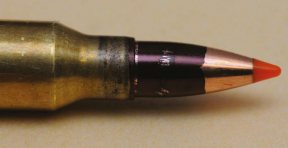
I’m sure you’ve already taken note of the point about same style, same weight bullets from different makers giving you a variation in optimum COL. That translates into a different position for the base of the bullet in the case and obviously, a different residual case capacity. Whilst our example of 2mm may be extreme, a variation of up to 1mm is not uncommon. Ergo, a change from the Whammo bullet to the allegedly identical Slammo bullet can have significant performance implications. More insidious is the effect of using the wrong nose punch to seat the bullets. If the punch bears down on the exposed lead tip of an SP or the insert in a V Max type of design then the chances are that the true seating depth of the bullet will vary from one cartridge to another. This creates a double whammy, the base position of the pill will vary, effecting internal ballistics, and the resulting nose damage will affect external ballistics.
The presence of a cannelure on bullet can lead to dangerous assumptions, especially in the very popular calibres. Whilst this impressed ring may represent an ideal crimp location for a pill in, say, the .300 Weatherby Magnum, it could have damaging results in a .30 M1 Carbine or .30 Herret.
click on image to enlarge
click on image to enlarge
click on image to enlarge
click on image to enlarge
click on image to enlarge
click on image to enlarge
click on image to enlarge