Gun Reviews >
 Find a Dealer >
 Find a Club >
 Competitions >
 videos >
 Reader Survey >
Gamo Riser Punisher: budget PCP tested
- Last updated: 20/07/2026




In the world of reasonably priced PCPs, the new Gamo Riser Punisher stands out as one of the best. Pete Evans offers some reasons why.
Last month we considered a usually expensive rifle, which, because of a few “issues”, came with a budget price tag. For those with a little technical skill, the Air Arms S400 was resurrected into the form of a highly usable field rifle, with just a modest outlay. I grant you that it still had cosmetic issues, but in the field it’s performance that trumps appearance every time.
For this month’s offering, I have decided to stick with the budget theme, but this time consider a new PCP aimed at those who just want to get shooting without the need for a workshop session.
The Gamo Riser Punisher (henceforth known as the Riser) is certainly a rifle which will not punish your wallet, offering much to celebrate. I’ll keep the price tag secret until the end, as I’m keen to let the excitement build before the big reveal.
Although it may be slightly confusing, the Riser is a development of the Gamo Arrow. The defining feature of the Riser is that it has a hardwood stock, rather than the synthetic one found on the Arrow. It may also be worth noting that the synthetic stock has a slightly different design: a longer forend and a sculpted cheekpiece.
From an ergonomic perspective, we have a rifle of 39 inches overall length, with a scoped weight (3-9x40) of 6.8lb. On paper, this equates to a carbine-length rifle, fairly light in weight, which bodes well for its use as a hunting companion. At first glance, you could be forgiven for thinking this is a heavy gun, although Gamo’s careful choice of materials ensures this is not the case.
In the hand, the gun feels solid, with a neutral balance at the shoulder and with just enough heft to ensure that it remains stable on aim.

Act quickly and you could get the Riser as a package complete with scope.
It’s a given that any PCP rifle is going to need a moderator. To accommodate this need, the Riser has been designed with an integrated synthetic shroud and moderator. The moderator itself has been christened the “Whisper Fusion” and is not removable, nor can a secondary unit be fixed ahead of it.
Being a suspicious type of person, I’m always keen to find out exactly what a manufacturer has done to achieve the goal of sound suppression. In the past, I have seen so-called moderators which are literally an empty tube, with no internal baffles to disperse the sound waves. This Whisper Fusion does have some red flashes peeking through the outer shell, which could be a hint as to what’s inside, but not satisfied with this, I set about getting a better look.
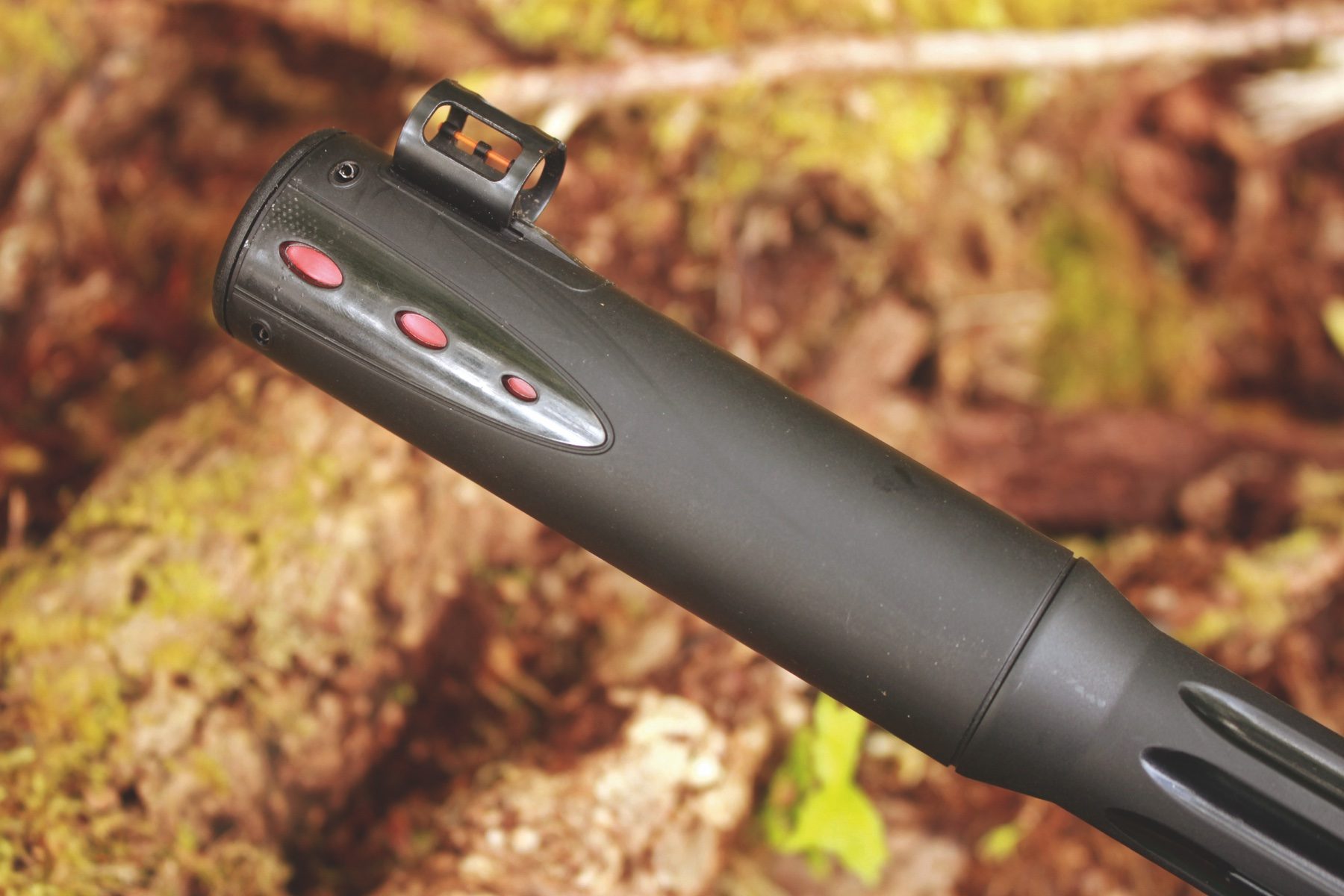 That flash of red suggests this is a functional moderator.
|
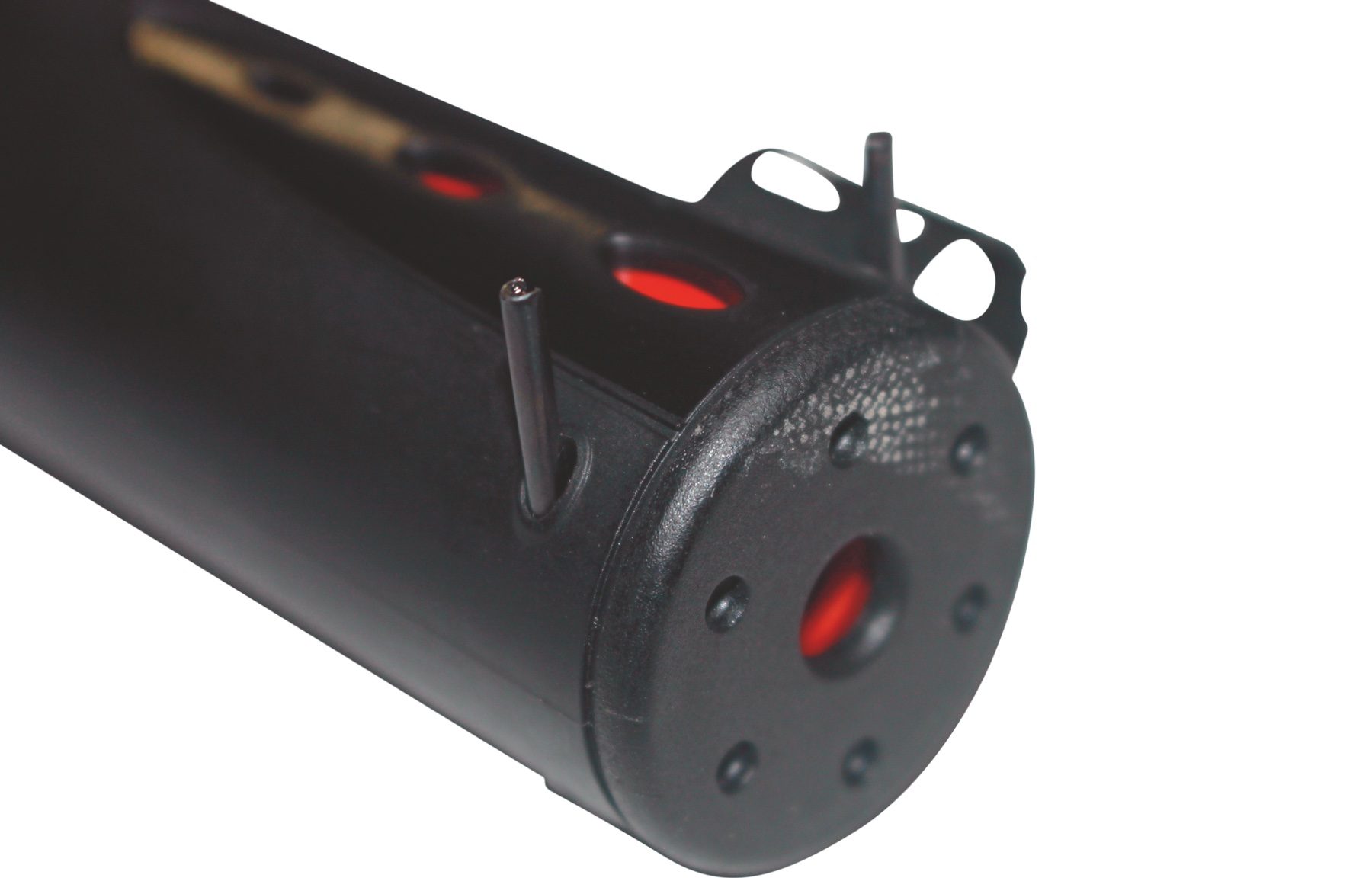 To get inside the moderator, drift out these two roll pins.
|
Thankfully, this is an easy process for anyone else with an enquiring mind. At the end of the moderator, there are two roll pins which secure the end cap, these being at 90 degrees to the barrel. Drift these out (they are unsplined roll pins) and remove the end cap. This will reveal the internal baffles, which can be withdrawn.
The baffles are made in two pieces which fit together like a clamshell, with a number of moulded air passages. Deep inside, the barrel crown is observable, which was clean and correctly finished. The ease at which this moderator strips makes it a cinch for those that like to experiment with different sound baffles, although I will say that the factory setup does a pretty good job of cutting off this gun’s bark.
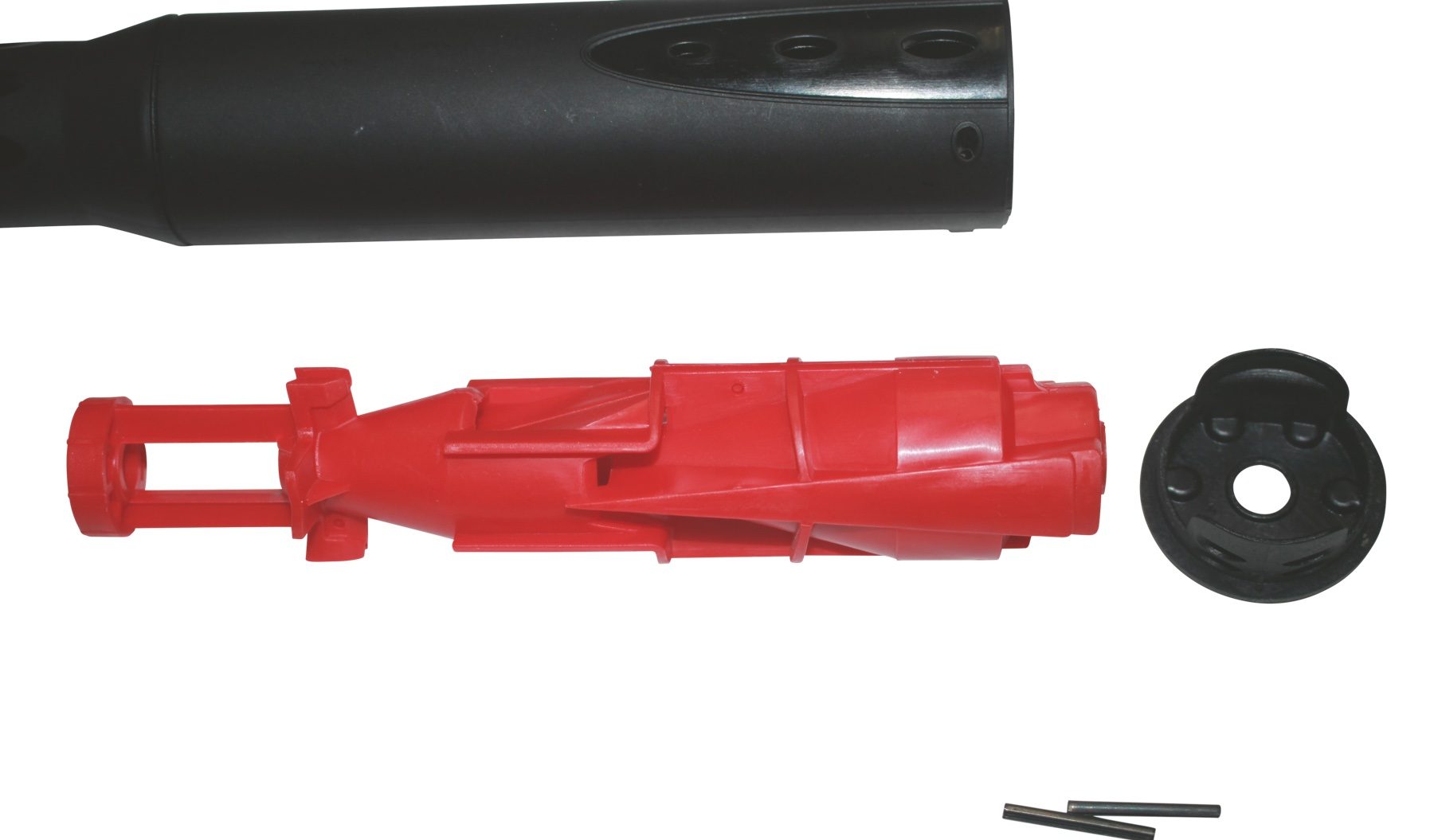 This pair of baffles are effective in reducing muzzle blast.
|
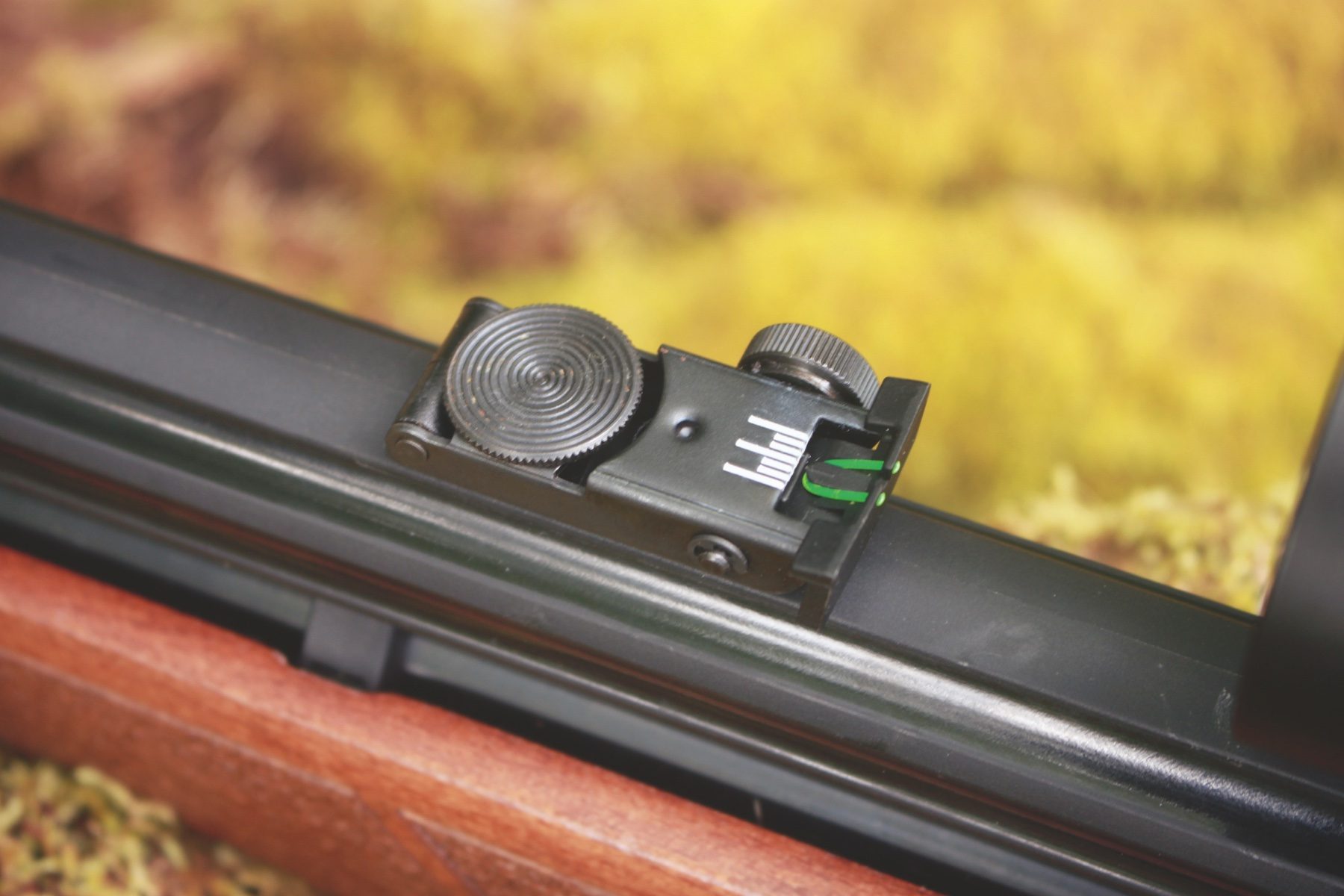 Not many pre-charged guns come with a pair of useful open sights.
|
While talking about the moderator, it’s worth mentioning that it also has the function of housing the fibre-optic fore sight. Unusual as it may seem, especially for a PCP, the Riser has a set of open sights. In fact, the rear sight, fully adjustable in all planes, is the same unit applied to the Gamo spring guns. Seen as old hat by many, open sights are a useful feature to have. Whether it be close-quarters pest control or back-garden plinking, open sights offer fast target acquisition with an unmagnified, reduced-wobble image.
The synthetic theme extends from the shroud to the breech and bolt. This undoubtedly aids in keeping the weight down, although I’m sure there will be some who will worry about its robustness. My own history with a synthetic breech dates back to my 1986 Sharp Innova. The scope rail has some crimps, but it’s still going strong after 40 years of use. Engineering-grade plastics have come a long way forward in recent years, so personally, it’s not a subject that I’m particularly worried about.
 The breech is synthetic, which means it’s weatherproof and robust.
|
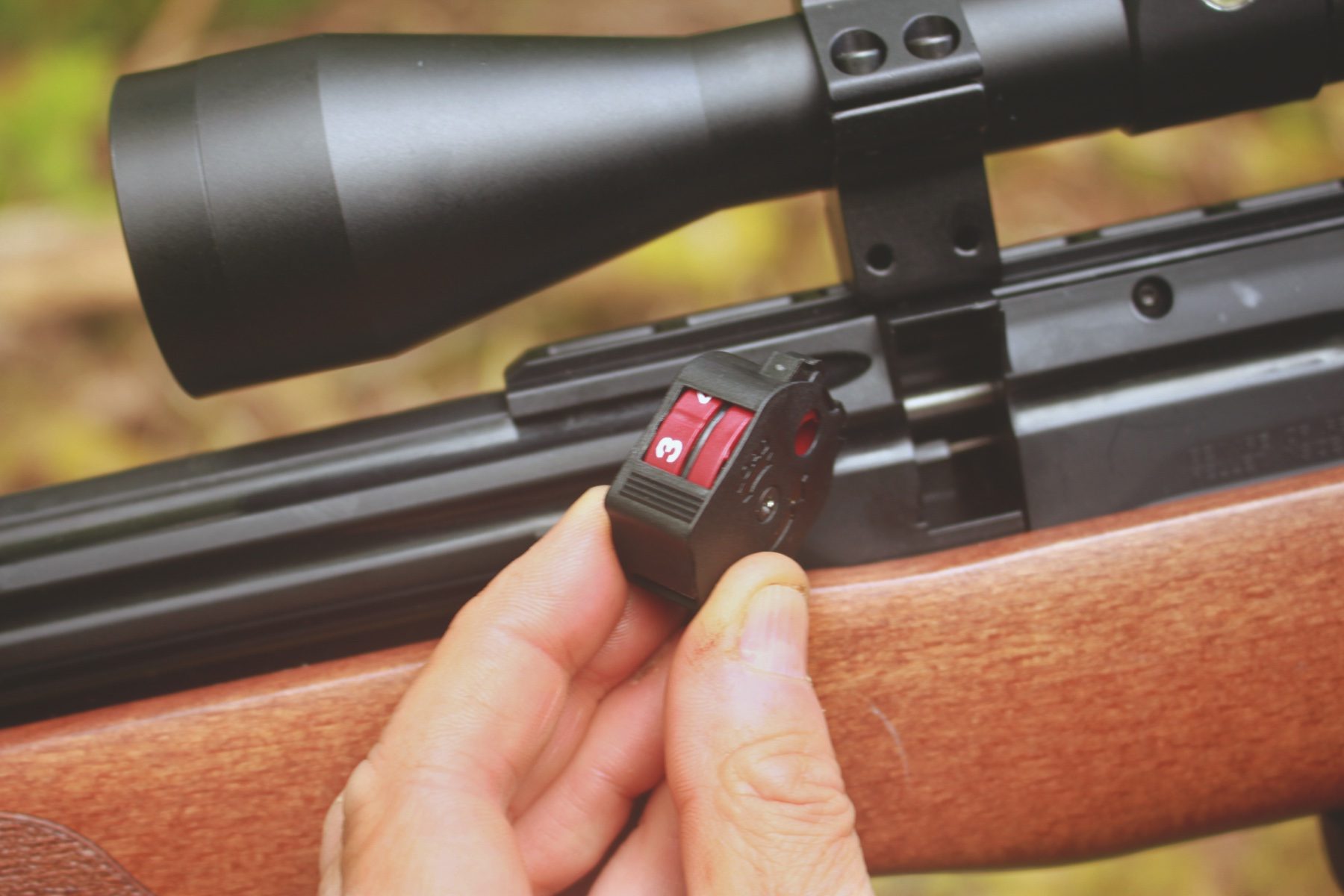 Simple rotary 10-shot magazine, which keeps track of the shot count.
|
Integral to the breech is a set of 11mm dovetail rails, as well as the arrowhead-profile cocking bolt. The bolt mechanism is worth contemplating, as it’s not a conventional design. Rather than a lock-down bolt, Gamo has gone for a straight-pull design, which locks in place with the forward push.
To release, push down lightly with the aforementioned arrow-shaped handle and then pull straight back to cock the internal hammer. Then push forward to seat the pellet; the bolt will then lock back into place. Two fingers (either side of the arrowhead) work well for the cocking stroke. In practice, this is a slick action which is easy and fuss-free to use.
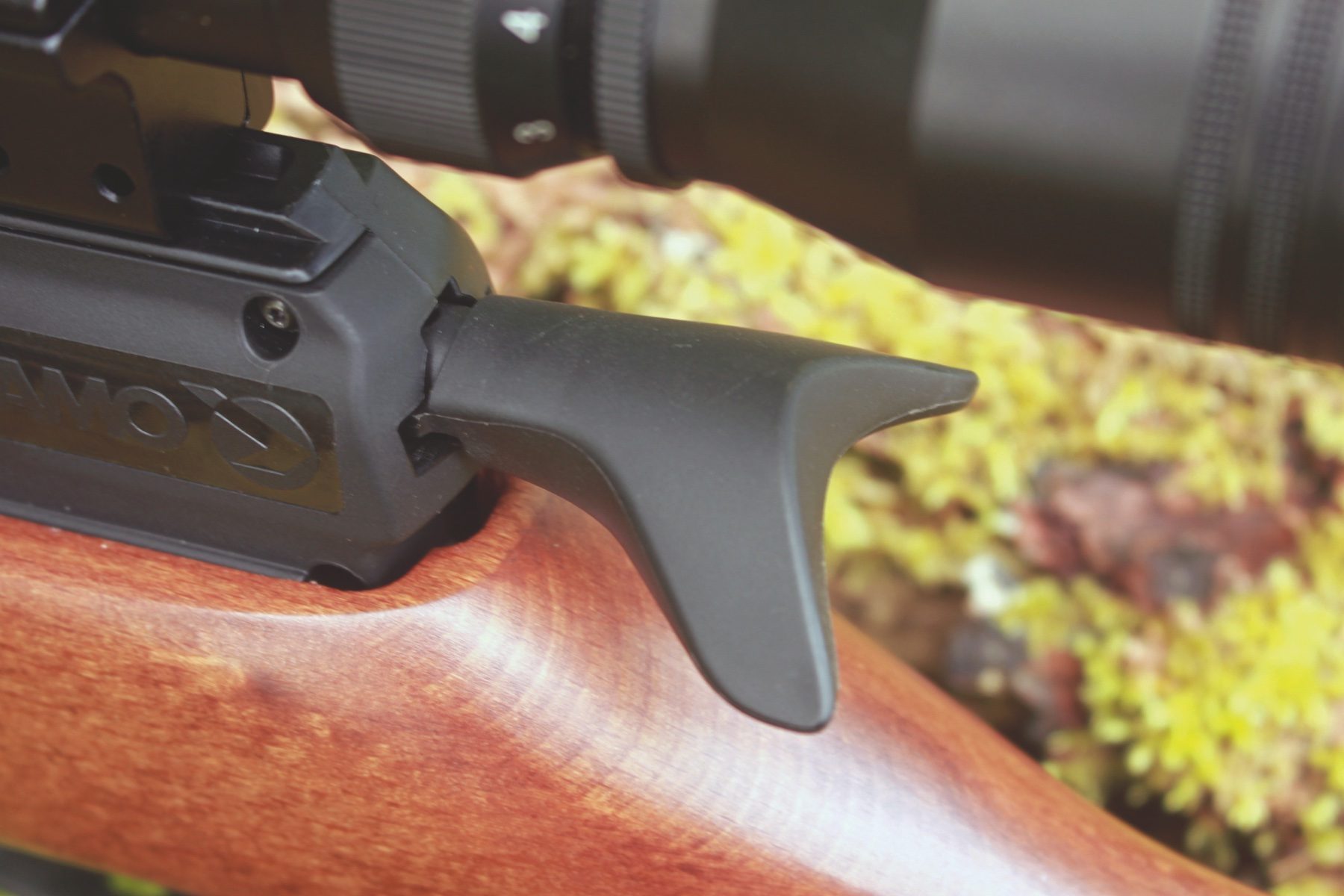 Just push down lightly on the “arrow head” to release the bolt lock.
|
 The tactile shape means the action can be cocked with two fingers.
|
The magazine has a 10-shot capacity with numbered chambers. To load, it’s just a matter of filling a chamber and then rotating the drum to receive the next. It is simple to use and has worked perfectly for me without any jams.
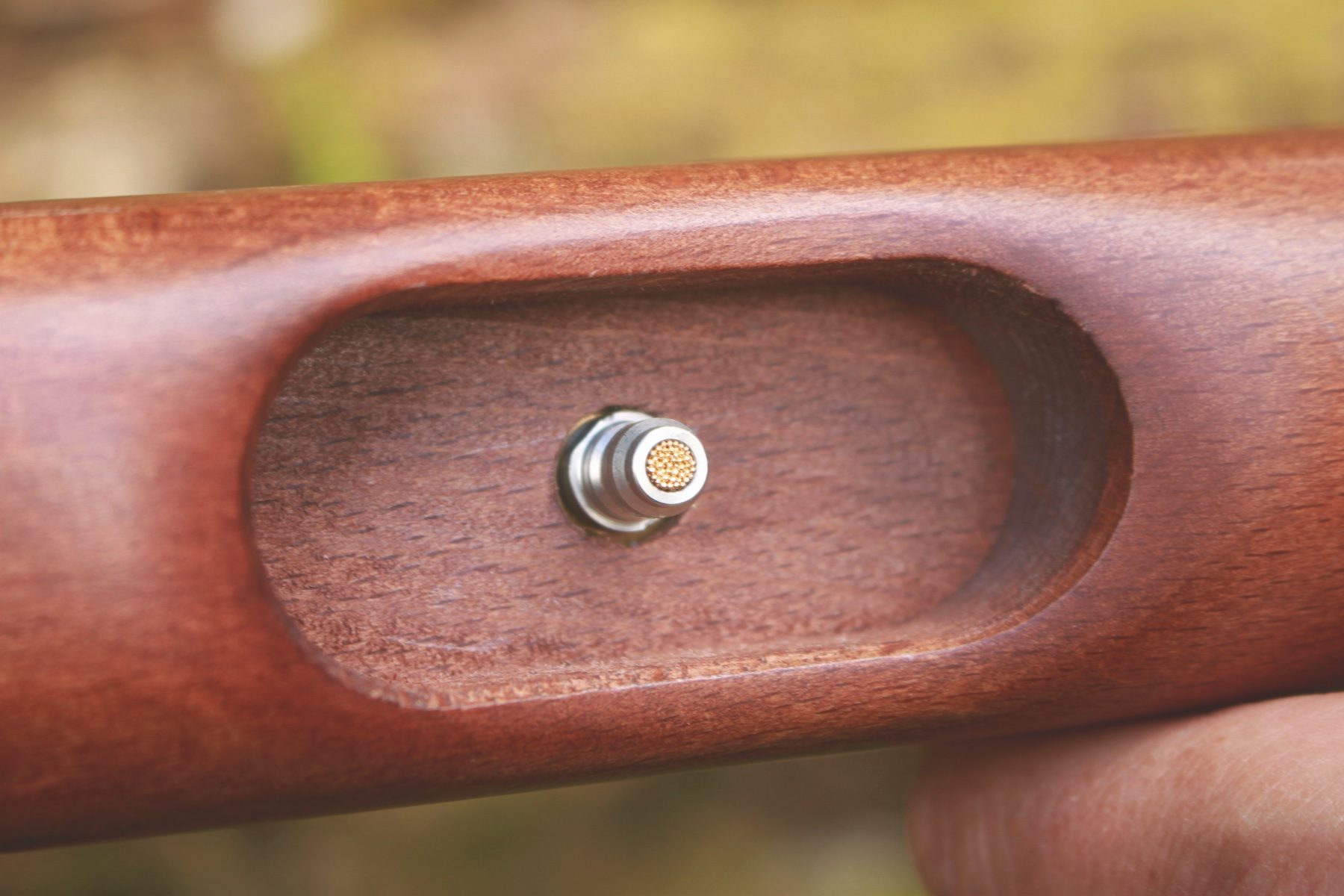 The standard Foster filler. Although there is a filter, a simple cap would be of benefit.
|
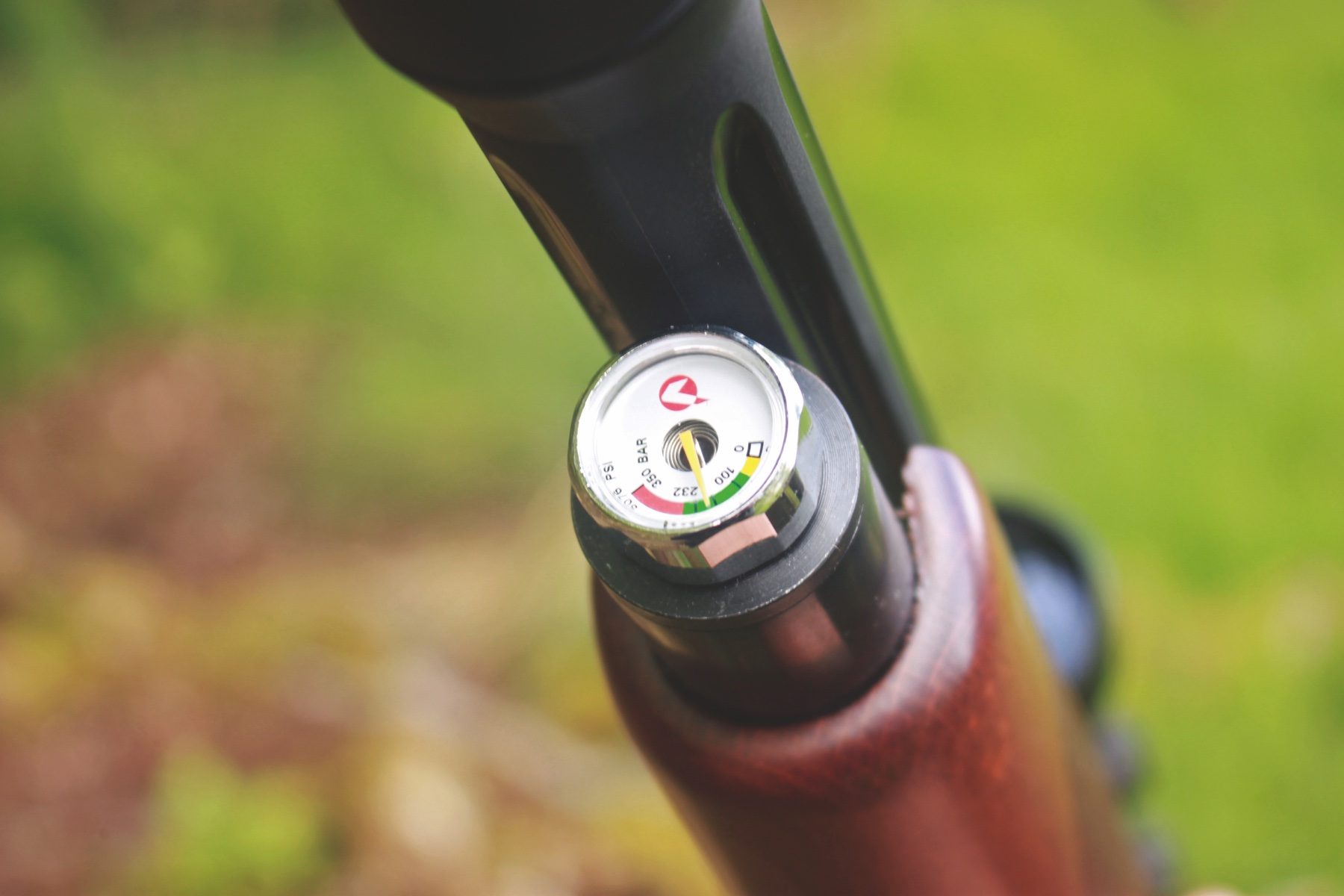 Keep a check on air supply: Pete favours a 180 bar fill.
|
Gamo has kept things simple by offering a standard Foster fitting to effect an air top-up. The filler itself is housed inside a large relief on the underside of the stock. There is a filter built into the tip of the filler, although I would recommend fitting a cover; a small magnetic one would work well.
A maximum fill pressure of 232 bar is mandated, although considering this gun is unregulated, I would recommend around 180 bar. This will give fewer shots, but those shots will be consistent, as the self-regulating valve will be working at peak efficiency. For the record, in .22 (this rifle), Gamo gives a shot count of around 80 shots per charge, which I presume is achieved using in excess of 200 bar. Using a 180 bar fill, I’ve been able to use five magazines (50 shots) with a variation of no more than 13fps. That’s a very good performance, so I will be sticking with this regime. To keep check on the onboard air supply, there is a gauge mounted at the end of the cylinder.
Being well acquainted with Gamo’s trigger design used on their spring guns, as well as the Mk1 Rapid 7, I was keen to see what this new custom action trigger (CAT) had to offer. To get a better look, I removed the stock, which was easily achieved by removing the Torx T25 screws from the forend and trigger guard. The two trigger adjustments available are accessible without removing the stock, although it’s easier to photograph removed.
 The two-stage trigger, which does offer some adjustment.
|
 The first stage trigger adjustment with a 1.5mm hex key through the blade.
|
The 1.5mm screw, accessed through the trigger blade, controls the amount of first-stage travel; advancing the screw clockwise reduces travel. It appears to be a pseudo two-stage device. In my case, advancing the screw a turn reduced the travel to my preferred state. The cross-head screw at the rear controls the amount of trigger engagement. This one needs to be adjusted with care, as you need to retain a safe amount of sear engagement.
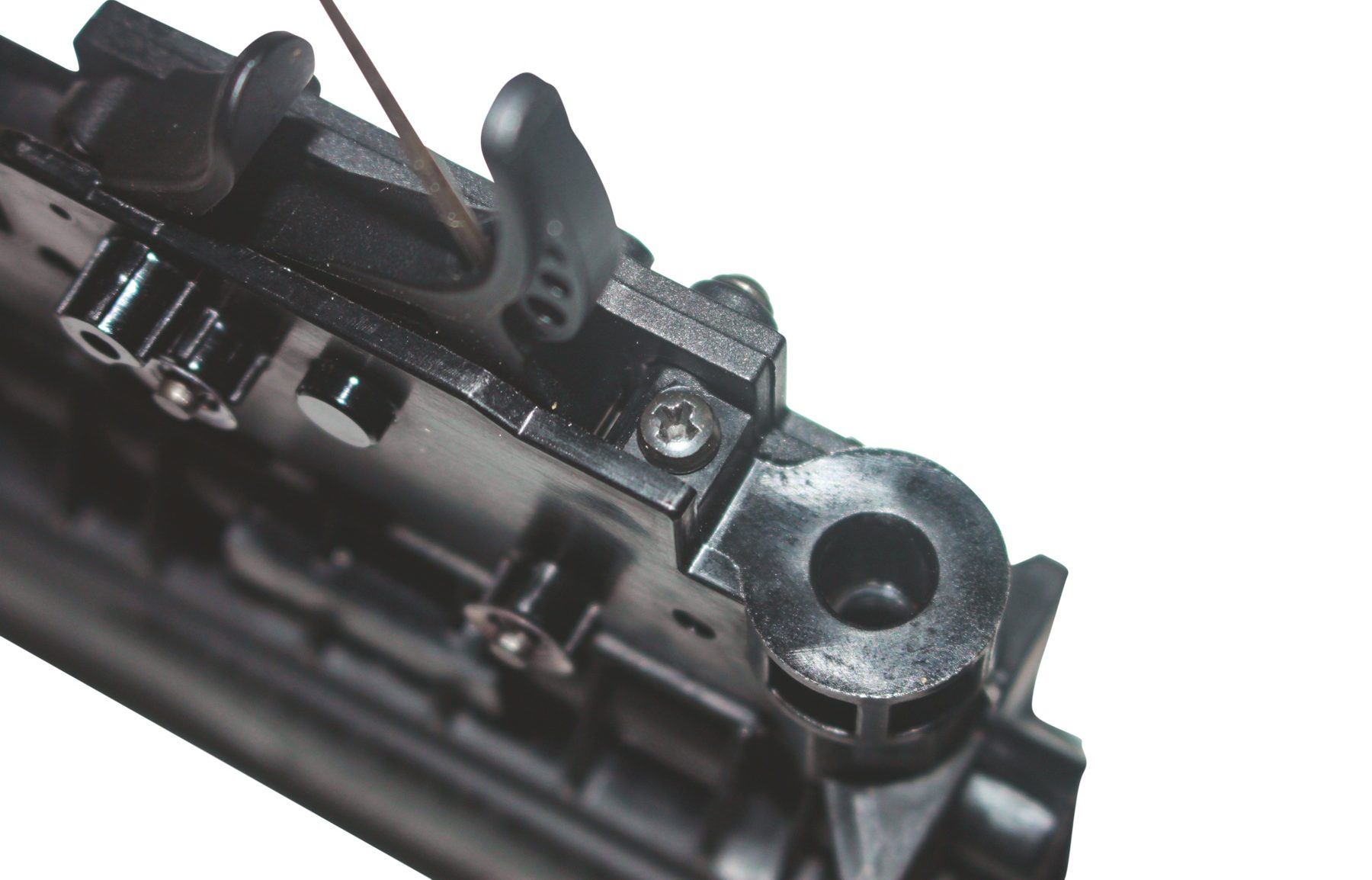 Second stage adjustment is available with this cross-head screw.
|
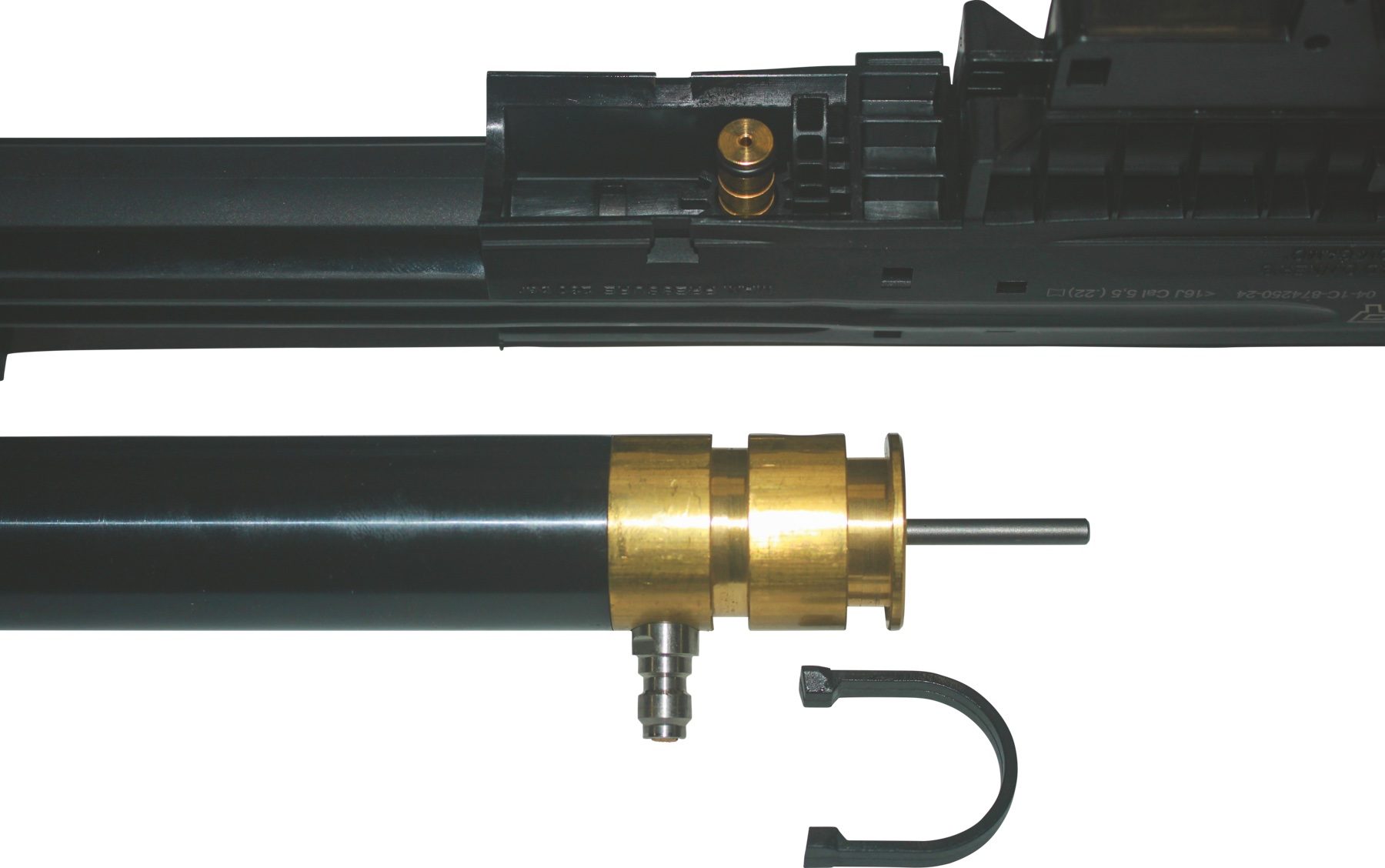 The cylinder and firing valve are held with two clips, removable without tools.
|
While not needing a rebuild, examining the internals reveals a gun which doesn’t seem too daunting to work on. The whole cylinder and firing valve can be removed in one piece without the need for tools, with just two clips to disengage. This leaves good access to the transfer port to change its seals.
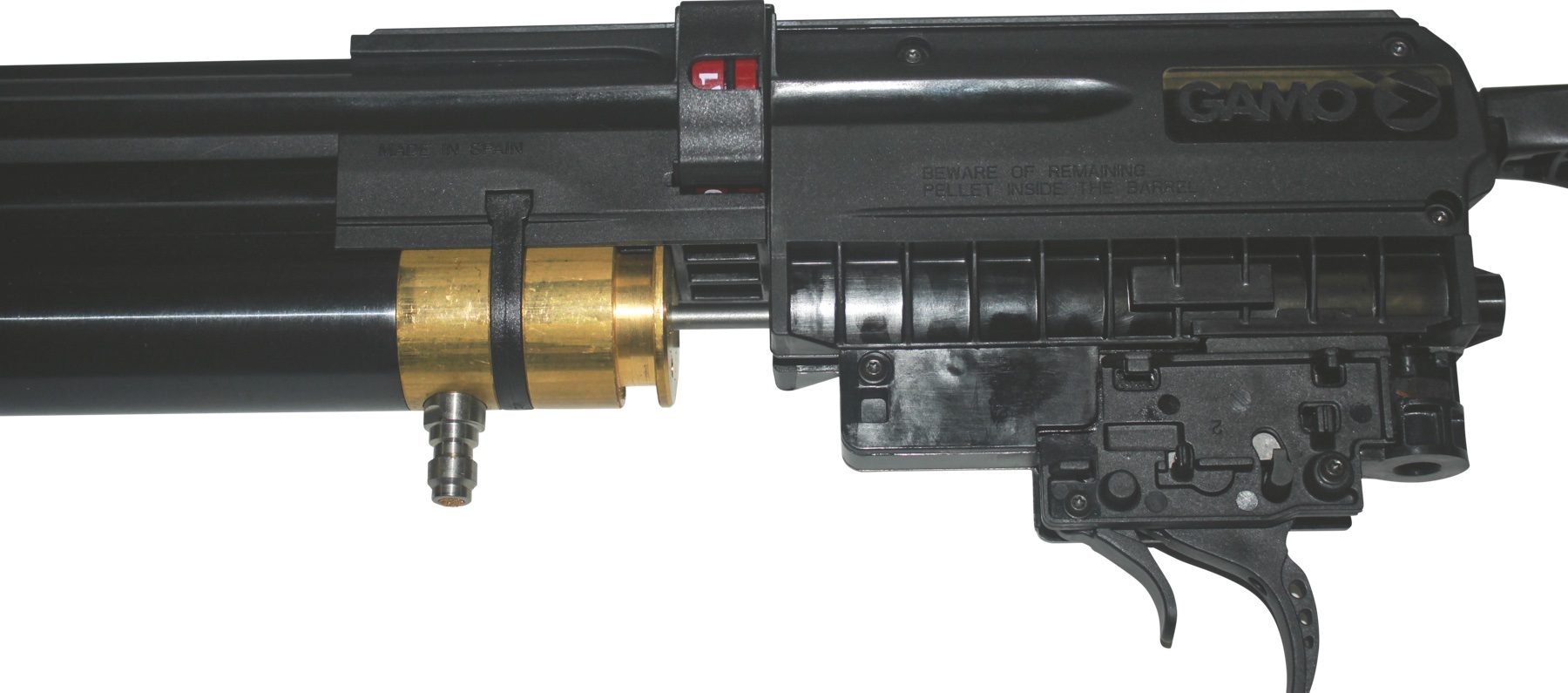
Taking the stock off gives a better view of the internal parts.
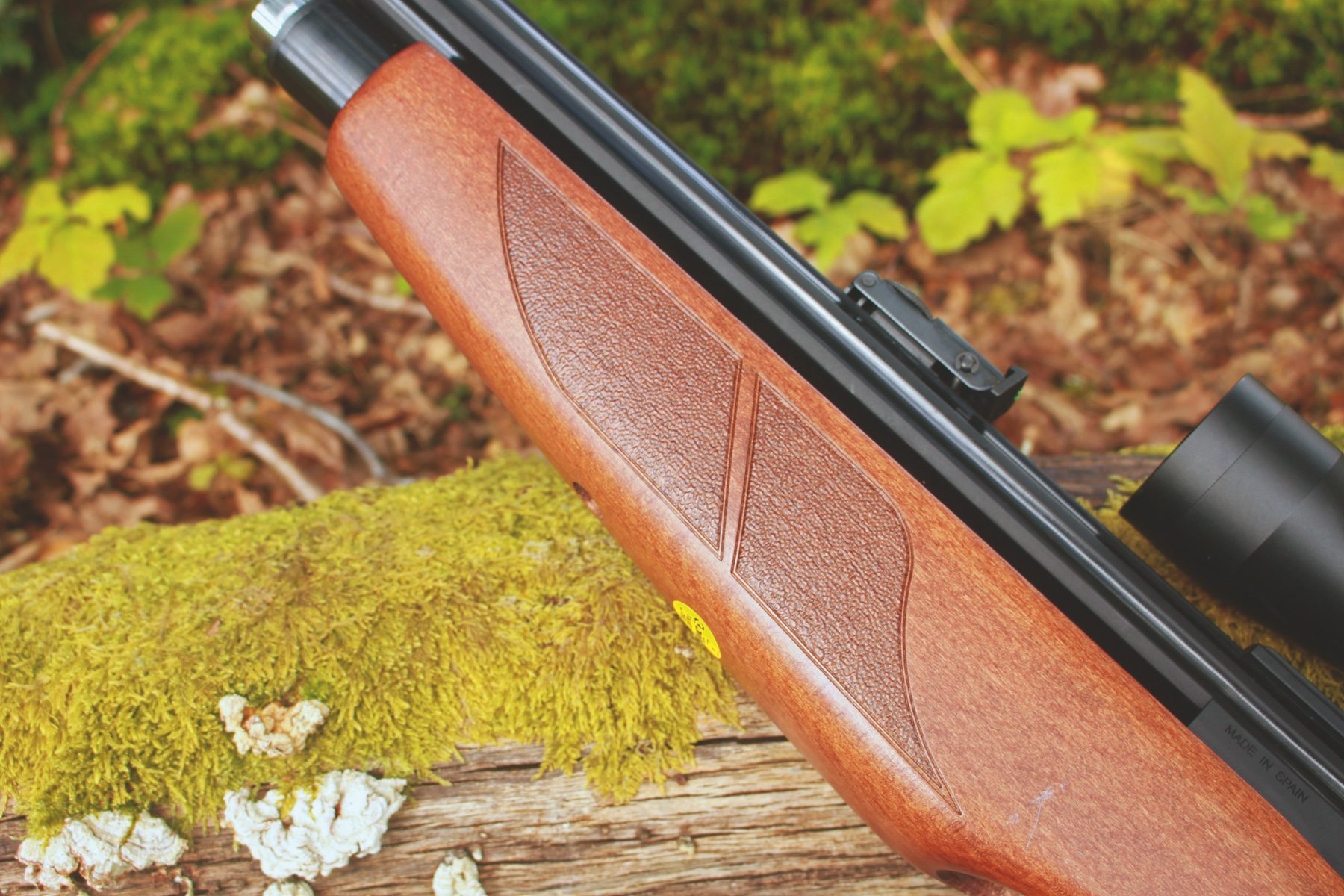 Pressed chequering on the fore stock will aid grip.
|
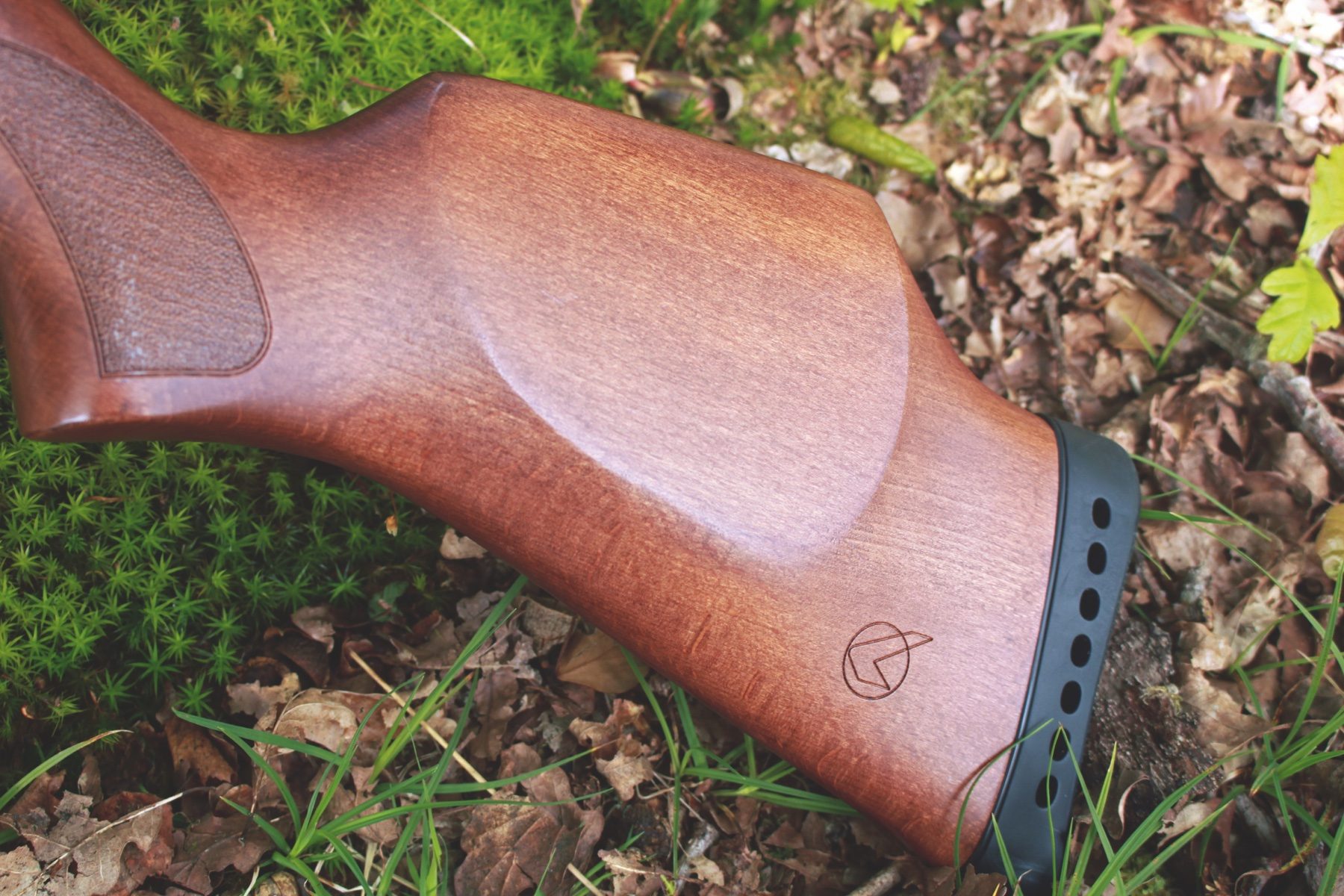 A right-handed stock, although only a gently raised cheekpiece.
|
Constructed from hardwood, the stock does its job without fuss or fanfare. Pressed chequering features at the forend and grip, the control features topped off by a rubber ventilated butt pad. While not truly ambidextrous, there is only a nod to it being right-handed, as the cheekpiece is not very pronounced. I can’t foresee many problems in using this gun in the left shoulder. If wood isn’t your thing, it’s worth considering the Arrow, with its black synthetic all-weather stock.
I’ve already established my ideal fill pressure and variation, but what of the power? Over the 50 shots recorded with a 180 bar fill, average power with JSB Exacts in .22 worked out at 10.9ft/lb. Enough safety margin there for use with heavy pellets, and certainly enough for my usual target ranges.
Accuracy turns out to be very good, with 25mm spinners continuously turning at 40m. It seems Gamo is on to a winner here, with a very reasonably priced package which is eminently suitable for use in the field, although equally usable for informal back-garden target fun.
It seems that the Riser has struck a chord with our friends in the USA, who seem very keen on this gun. Of course, theirs are running at much higher power levels than here in the UK. On a local level, I know that these guns are literally selling like hot cakes, principally because my local RFD (Neath Gun Shop) has them on special limited offer. All of which leads me to the price of this very appealing package.
The Riser and Arrow are currently supplied to the gun trade by Edgar Brothers, which has been offering some special limited availability package deals. On the Edgar Brothers site, you will find the Riser supplied with one magazine for an RRP of £325, which is a very attractive proposition. If you are lucky (and quick), you might be able to bag one of the special packages which includes two magazines and a 3-9x40 scope, typically for not a lot more.
I’ve already mentioned my local RFD, Neath Gun Shop, and the fact it has gone a step further. A step further insofar as a huge reduction on the package deal; for a limited period, it can be had for a staggering £199. An unrepeatable offer, of which I availed myself, and available while stocks last.
Whichever route you take, the Riser offers serious value for money. Hats off to Gamo for offering pre-charged performance for spring gun money.
Visit edgarbrothers.com and neathgunshop.com for more information on this air rifle.
Prices are RRP at time of publication and may have changed since.
The RRP is £325 with one magazine, from distributor Edgar Brothers. Package deals with two magazines and a 3-9x40 scope have been offered for not much more.
The Riser is a development of the Arrow, and the defining difference is the stock: hardwood on the Riser, black synthetic on the Arrow. The synthetic stock has a longer forend and a sculpted cheekpiece, and is a little lighter.
Gamo mandates 232 bar maximum, but because the rifle is unregulated, Pete recommends around 180 bar. On test, 50 shots at 180 bar varied by no more than 13fps.
No. The Whisper Fusion is integrated into the shroud and cannot be removed, and no secondary moderator can be fitted ahead of it. It can be stripped for cleaning or experimenting by drifting out two roll pins.