Gun Reviews >
 Find a Dealer >
 Find a Club >
 Competitions >
 videos >
 Reader Survey >
Immersive Optics 10x24 MD
- Last updated: 22/06/2023



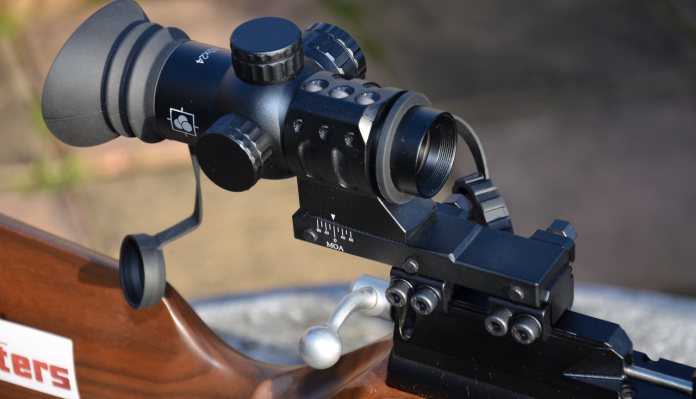
As an enthusiastic HFT shooter, it has been interesting to see the sport evolve, and with the emergence of a raft of kit, aimed specifically at the competitor who wants to exploit technology to push performance, the choice of sighting systems and permutations available are now truly astonishing. Ultra-short eye relief has been one of the governing factors in all this, as this can help minimize parallax error. The scope on show here is one of the new breed of prismatic models from Immersive Optics, and for those who have never experienced this type of optic, let me tell you it’s radical, to say the least!
Open the neat protective box and you’ll find the sight unit itself, instructions, lens caps, lens cloth, and three separate mount bases. There are several models in the range, and mine here is the Immersive Optics 10x24 MD, which, with a fixed 10x mag, is a handy spec for both HFT competition and hunting.
At under 5” in length, this optic is roughly half the length of a conventional scope, plus part of the remit is for a sight that will fit awkward setups. A bullpup rifle with restricted mounting is just one example, but the sheer lack of bulk could be a big plus point in itself. At this stage though, there’s an important caveat. This particular model is not suitable for recoiling guns, due to that super short eye relief, so unless you fancy running the risk of a black eye or worse, take that warning seriously!
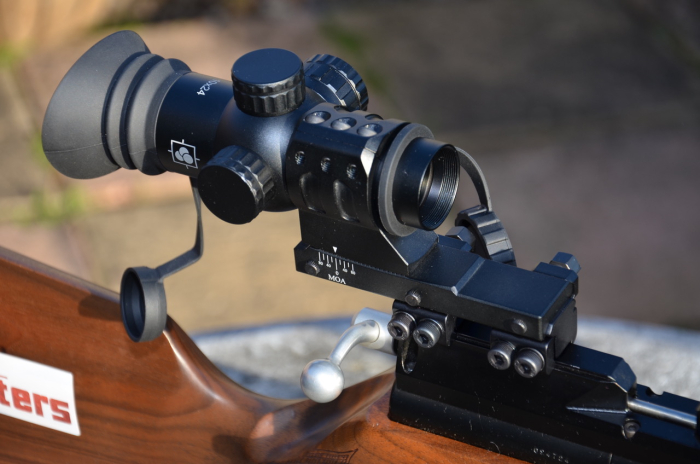
The soft lens caps are a push-fit. They can either be left hanging, or removed if necessary. In addition, there’s a soft rubber eye shroud for the rear, again a push-fit to connect, and this is handy for eliminating back light to the ocular lens. The optic is held by a dedicated diagonal mount clamp, and this then connects to one of the three bases that come supplied (3.5”, 3.75”, and 5.3”)
Pick the appropriate length mount base for your gun, and then tighten, first to the sight using the three bolts underneath, then in place on the rifle using the Picatinny profile. I used adaptor blocks from Sportsmatch on test, as I was fixing to dovetails, and this worked fine.
Clever design comes with the way the sight can be roughly zeroed by adjusting the angle of the mount in the base, and to this end, there’s a small graduated scale on each mount. Take advantage of this, and centre the optic first, adjusting the turrets to their mid-point before you start, minimizing stress on the internals. Now, fire some shots and check the point of impact. Make a note of exactly where the mount is on the gun’s rails, then make a note of where the sight body sits within the graduated scale on the base. Remove the sight, slacken the three bolts on the underside of the base, and gently slide along the curved base. Tilting the front of the scope down will raise the point of impact, and vice versa. Re-tighten, and fire more shots. Repeat the process, and when you are near to zero, finally use the turrets. If it sounds complicated, it’s not. Effectively, there is loads of adjustment, but you can ignore the base system and just tweak the turrets in the usual way if you want. The turret clicks are positive and audible, with values of 0.1 Mil.
Parallax error can be corrected with this sight by turning the left-hand side turret, and there’s even a small set of stickers to use to add distance figures to the inside ring of the dial. Personal eyesight means reading range markings can be irregular, so being able to personalize readings is a neat feature. Not so important as with an FT-style scope, but handy nonetheless.
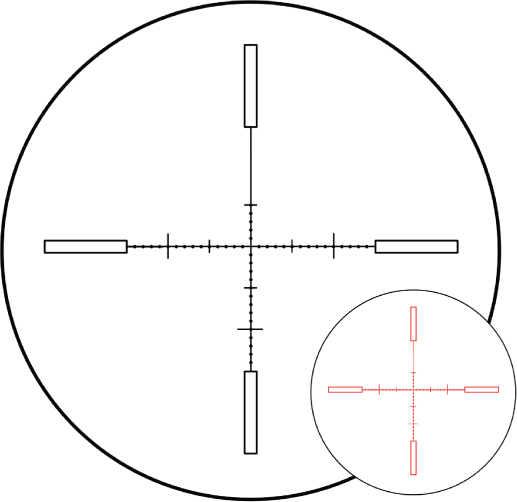
So, how does it feel in use? Well, with the soft rubber shroud in place, the sight can be gently mounted against the eye socket (this is the reason why recoiling guns are out!), and with the ultra-short eye relief (0.6”) all part of the remit here, along with the prismatic system, the resultant huge field of view, when compared to conventional scopes, is well and truly eye-popping. The Mil-Dot reticle is a pleasing design, but having used the 14x50 model recently, fitted with the Extended Mil-Dot reticle, the MD (Mil-Dot) reticle on this 10x24 is a thicker, bolder design, which is just a little less precise. That said, the upside is that it will be easier to see the reticle when taking on targets in darker foliage. The reticle (entire diagram) is also illuminated in red, with the power coming from a CR2025 battery that’s concealed inside the left turret cap. Simply press the central button to illuminate. On test, it should be noted that the reticle only had one brightness setting, either on or off.
Immersive Optics specify ED (extra-low dispersion) glass for this sight, and all I can say is, on test, I couldn’t fault the image in terms of clarity and brightness. Versatility is high on the list, and with this model sporting that fixed 10x mag, set the parallax to around 25 yards and you have yourself a handy HFT rig. Usable clarity through the target distances of 8-45 yards, and use the Mil-Dot system as proportionate reference points.
Personal preference plays a big part in our world, and when it comes to radical kit such as the optics on test here, perhaps never more so. Having the sight make contact with the face whilst shooting will be a step too far for some. However, get past that side issue, and the benefits of the prismatic configuration can be fully explored. So, super-short eye relief, minimized parallax error, a huge field of view, the ‘eyes wide open’ shooting sensation, and ultra-compact dimensions make for an attractive proposition indeed. Add in that cleverly executed adjustable mounting system and these neat little sights have much to offer, either as an HFT tool or as a go-to hunting sight.
click on image to enlarge

click on image to enlarge

click on image to enlarge

click on image to enlarge
click on image to enlarge

click on image to enlarge