Gun Reviews >
 Find a Dealer >
 Find a Club >
 Competitions >
 videos >
 Reader Survey >
HAWKE VANTAGE WA 4-16X50 RIFLESCOPE
- Last updated: 12/03/2025



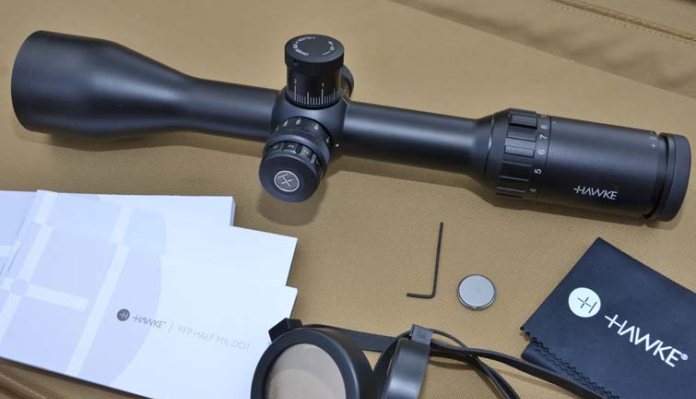
Hawke Optics continues to evolve its range of scopes, and it caters for a number of disciplines across the board. Looking at its latest price structure, the Vantage range represents what could be considered the value end of Hawke’s product portfolio. Yet, that should take nothing away from what’s on offer here. At £329, this Vantage WA 4-16x50 IR SF FFP is no bargain option, and first impressions on opening the box are of a big, bold scope. It looks and feels well made, and at 26.3oz, it’s no lightweight either, representing a significant addition to any rifle setup.
Comprehensive
Alongside the scope itself, you get elasticated lens caps, a lens cloth, a battery, Allen keys, and comprehensive instructions. I say comprehensive because there’s actually a set of three mini instruction books. One deals with optical zeroing and alignment, one covers the reticle design and the relevant values, and the main one covers mounting, setting the ocular fast-focus dioptre, parallax adjustment, turret adjustment, zeroing, maintenance, and the difference between second and first focal plane scopes. So yes, pretty comprehensive, and Hawke should be congratulated on that score. If you’re new to our sport, there’s a lot of data to take in at the outset, and Hawke has broken it down into digestible elements—a thorough approach that should be applauded.
Tech spec
So, it’s time to highlight the technical specifications on offer. For a start, this model sports a 30mm body tube and a monotube chassis construction for added precision and integrity. The matte black, non-reflective finish is ideal for field use, and the bold, target-style exposed turrets are clearly etched with elevation and windage markers. I’m not a fan of large turrets, as they create an unnecessarily wide profile, yet these feel precise, with 1/10 MRAD click values. Vantage scopes feature Hawke’s System H2 glass, which means 11-layer, fully multi-coated lenses.
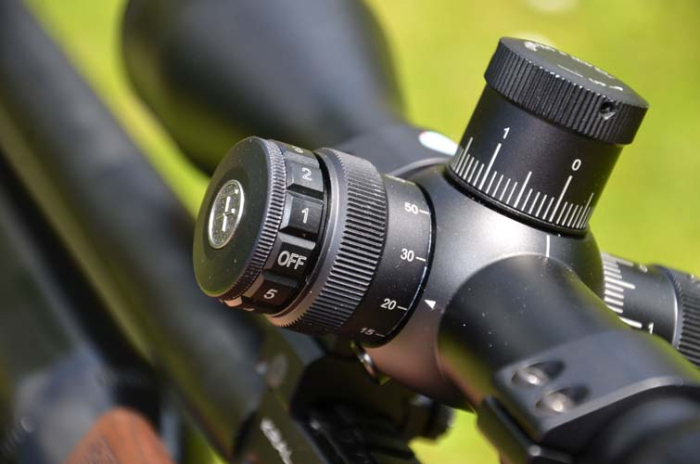
The sizable turret on the left-hand side of the saddle is the side-focus (SF) element of the model’s name, as it controls the parallax adjustment, and it also features the illuminated reticle (IR) control on its tip. As usual, the battery sits under a screw cap.
Setup and handling
On the range, the first task was to adjust the rear dioptre/fast focus to bring the reticle in sharp along with the subject. The dioptre is rubber-coated and offers just the right amount of resistance, as does the ‘high-torque’ zoom ring. The parallax dial is marked with a minimum of 10 yards, then 15, 20, 30, 50, 100, 200, 500, and infinity. In use, this dial proved to be pretty stiff, but I am sure it is likely to ease up a bit with use.
The turrets feature a push/pull locking mechanism—pull up to open and make adjustments, then push down to lock. All adjustments proved positive and audible, which is always reassuring, and the standard around-the-grid test came in with repeatable precision. As for image quality, all I can say is that I had no complaints. This model is specified as having a wide-angle view, and along with the sizable field of view (FOV), the clarity and edge-to-edge sharpness are hard to fault, as is the vibrant image itself.
FFP
In this Vantage’s specification, FFP denotes First Focal Plane, meaning the reticle’s subtension values remain the same regardless of the magnification setting. As the name suggests, the FFP half mil-dot illuminated reticle has been specifically designed for FFP scopes, with half mil-dot markings out beyond 5 mil in each direction. The outer posts in the reticle design show main segments that are 1 mil and some smaller segments that are 0.2 mil, meaning plenty of versatility, and an incredible number of aiming/bracketing markers.
The reticle is glass-etched for added robustness, and as for the illumination, the rheostat is marked with five stages of brightness in red, then off, then five more stages in green. It all works well, making this a highly versatile tool in a hunting scenario.
Verdict
Standard guarantees are included, and this Vantage is specified as nitrogen-purged, shockproof, waterproof, and all-calibre-rated to boot. Don’t forget Hawke’s conditional lifetime warranty either, which, coupled with their respectable after-sales service, should ease any concerns. Back to the price differential, it’s interesting to consider that a similar specification to that offered here, from Hawke’s Frontier range, would come in at around the £900 mark. It’s a classic case of the nth degree, as paying for supposedly higher-end glass and quality will buy you, on the face of it, a small benefit for a big outlay. Where glassware often comes into its own, and the differences show up, is when shooting in low-light conditions. But for more general duties, this Vantage really is hard to fault. I think it’s great value too, given what’s on offer. Indeed, whilst checking specifications, I happened to notice that this particular Vantage model actually shows a £50 price drop over the last year, so Hawke is obviously working hard behind the scenes to ensure that their line-up of scopes remains competitively priced. GM

click on image to enlarge

click on image to enlarge

click on image to enlarge
click on image to enlarge

click on image to enlarge

click on image to enlarge

click on image to enlarge