Gun Reviews >
 Find a Dealer >
 Find a Club >
 Competitions >
 videos >
 Reader Survey >
Hawke Endurance 30WA
- By Pete Moore
- Last updated: 09/07/2023



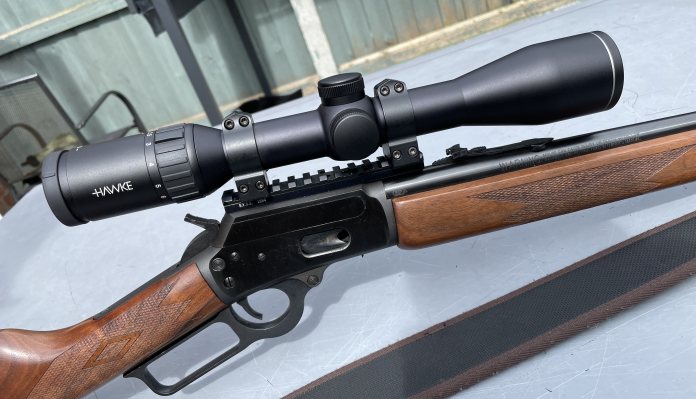
Cards on the table, I really rate what I term as ‘compact variables’. So, a scope that is not too big or heavy, and offers a magnification spec of 1-4x or 1/1.5-6x. Normally, these sorts of numbers mean a 30mm body tube and an objective lens of between 24 and 44mm. I have a Schmidt & Bender Zenith 1.5-6x42 on my R8/8x57 barrel and a Leupold VX7 1.5-6x24 on my Browning Maral in .30-06. Both punch well above their weight.
With your average hunter’s penchant for higher magnification optics these days, you might consider what power you actually shoot at. More mag means you can see more of the target at longer ranges, but light transmission goes down, and the wobble factor while trying to keep the reticle steady, goes up. My all-time favourite scope is a Swarovski Z8i 1.7-13.3x42, and very rarely do I wind it up past x8, if that, as it gives a brighter image and better dusk/dawn performance.
With this in mind, I have been building up a Marlin 1894 lever-action in .44 Magnum for woodland stalking and wanted a compact variable for it. I decided to see what Hawke Sports Optics had to offer. With my above comments and caveats, I borrowed an Endurance 30, WA (wide angle) 1.5-6x44, which has a modest price tag of £549 (SRP).
The scope comes with bikini lens covers and a 4” sun shade, plus is fitted with a CR2032 battery for illumination. It measures 13.2” long and weighs in at 20.1 oz. The mono-body tube has a 30mm diameter and there’s plenty of mounting space available.
Hawke uses high-grade, low-dispersion Crown Glass, with 18-layer, fully multi-coated lenses. There’s a high-volume eye box, a fast focus system, and a hi-torque rubber magnification ring. The 44mm objective lets in a good amount of light and proved effective from dawn to dusk, plus it’s not too large, meaning it can be positioned near the bore line with the correct mounts. It’s nitrogen-purged and shock, water and fog-proof as standard, with Hawke’s no-fault lifetime warranty.
The illumination drum is on the left of the saddle and offers six brightness levels, with individual cut-off points in between. I have always found this system most practical, as you can select the level you might need, then go one click past to turn it off, then a quick click for on when required. The CR2032 battery sits under the exterior cap.
The turrets are capped, so very much ‘set & forget’. The drums are marked up for 1/4 MOA clicks and can be returned to zero by slacking off the big slot head screw on top. Hawke quotes a total movement (top to bottom and side-to-side) in both elevation and windage of 180 MOA, which I considered to be more than enough.
In fact, you get 15 MOA per turn and 13 full revolutions in elevation. That’s a total of 195 MOA, so 15 more than quoted, which is impressive. When I was zeroing the Marlin, the loopy trajectory of the .44 Magnum was shooting very low, and as I kept winding the clicks in, I thought I would not have enough, but never ran out.
Windage is the same, which is massively over-generous for this plane, but comforting nonetheless. The drums are marked in 1/4 and 1 MOA divisions, the only real difference is that windage is split from 0-7 in each direction, whereas the elevation clicks show up/down from 1-15.
Visually, this model is a bit longer and heavier than other scopes in its class, and surprisingly, it comes with a sunshade, which is not the sort of thing you really expect or need. I was initially uncertain about the low number of illumination settings, but what was on offer proved adequate for all situations.
The reticle is what Hawke calls an L4A DOT and consists of what I would term a basic L4-type pattern, with three thick posts at 3, 6 and 9 o’clock, that stop short of the middle, which allows fast and effective framing of the target. The thinner, inner cross extends inwards from the outer posts at 12, 3 and 9 o’clock. It stops just short of the centre to offer a free-floating aiming point, which is the only thing that lights up.
The reticle is in the second focal plane (SFP) and is correct for values at x4 magnification. For example, 30” spacing from centre to post at 100 yards on x4, or 83 cm at 100m. From the hunter’s perspective, all of this is a little irrelevant, as you have a practical design that allows you to see lots of the target and place it well, with the advantage of the illuminated central dot. On scopes like this, there’s no time to be taking off caps and dialling in range, it’s not what they are about. Just work out your drops, set your magnification, point, hold over, and shoot. You’ll be on target.
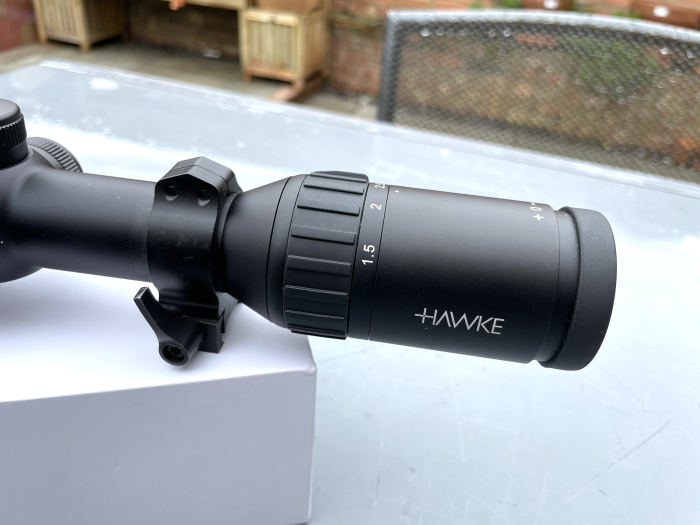
In use, I have no complaints. The big and grippy magnification ring means fast changes in mag. A generous 100mm (4”) eye relief means it will even work on heavy calibre rifles, and I’d happily put this on my .375 Ruger M77 African big game rifle. At x6, and at most sensible hunting ranges, you can see enough of the target to check it out and place the shot. It’s not big, it’s not clever, but it is totally built for purpose.

click on image to enlarge
click on image to enlarge

click on image to enlarge

click on image to enlarge

click on image to enlarge

click on image to enlarge