Gun Reviews >
 Find a Dealer >
 Find a Club >
 Competitions >
 videos >
 Reader Survey >
Schmidt & Bender 12.5-50x56FTII
- Last updated: 16/12/2016



Take a look down the firing line of any top Field Target event these days, and it soon becomes clear that the sport has evolved somewhat from the all-comers jamboree that it used to be. Full blown, dedicated match rigs are now the order of the day at the top, with the likes of Air Arms, Steyr and Walther regularly doing battle up and down the country.
What really sets this flagship sport apart though is the ultra sophisticated glassware that sits on top of those FT match rifles. High magnification is the order of the day, in order to create a shallow field of view, and x32 is about the minimum used. March scopes pushed the boundaries with an x80 magnification model, yet despite this, incredible feat, most competitors seem happy with x50.
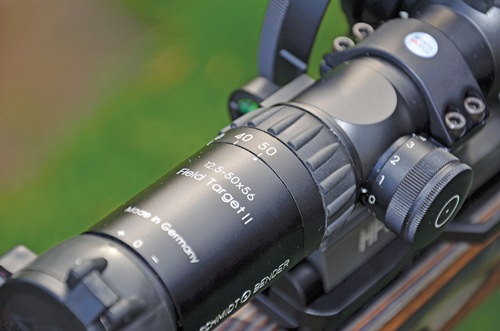
Top German optical company, Schmidt and Bender, threw their hat in the ring with a dedicated FT model some years back; but FT shooters are by necessity, a fastidious bunch, and despite some success on the competition circuit, a few reported problems circulated. Slight inconsistencies in range readings, caused by temperature change, is a problem that besets pretty well all the leading scopes to a greater or lesser degree, as different metals expand and contract at different rates; yet the boffins at S & B have been busy. The result is a new model from this iconic brand- the 12.5-50 x56 FT II Sport 3 model, on test here. Little is given away with regards to the internal changes, but having spoken directly with the factory, it has been confirmed that the optical design has been ‘re-calculated’.
As you would expect from such a premium grade product, many features can be specified by the end user, and we’ll take them in turn. Before, that some basic assembly is in order.
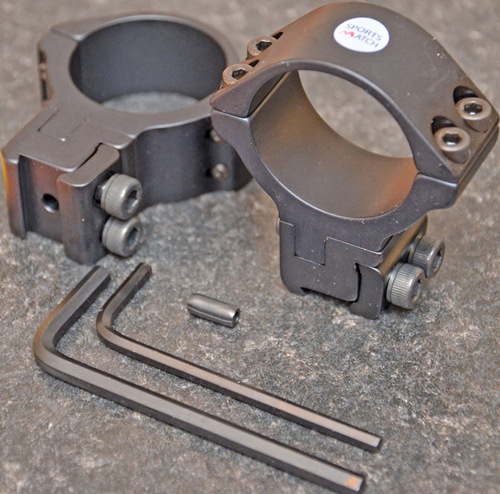
Most FT scopes are quite weighty machines, given the complexity of the parallax adjustment system on board, and this new model tips the scales at 2.8lbs- some 4oz more than the old version. For my test, I first needed to source some 34mm diameter mounts, and a quick call to Sportsmatch soon put me right. Their dedicated adjustable twin ring mounts ATP34, are just the job for this grade of glassware, and with a comparable level of build quality, they truly compliment the set-up. They’re adjustable too, so the scope can be zeroed and optically centred almost entirely within the mounts, just requiring a tweak to fine zero.
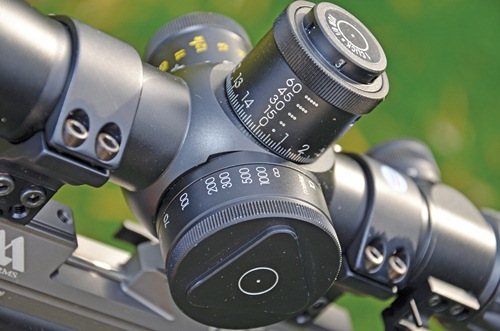
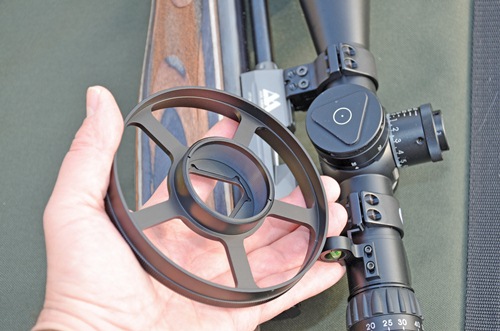
This scope comes with a side parallax dial 47mm in diameter. This comes factory marked with ranges from 10m, then 20m, 30m, 40m, 50m and 60m. An add-on side wheel, measuring 130mm then locates onto this. Schmidt and Bender have opted for a push-fit connection with a strong magnet, and here the wheel just pushes onto the triangular hub. With the wheel in place, the other accessory included, is that finely machined spirit level and range marker. This
Target turrets come as standard with this model, and all etched markings are ultra precise. Click values are 1/8 MOA on the test model, but can be specified in ¼ clicks too. Turn the turrets, and the sheer class of the ultra robust mechanism is instantly obvious. That oversized 34mm body tube (the old model was 30mm) allows for a bold sight picture as field of view is significantly increased.
These scopes can be made with first or second focal plane, and a choice of reticules is available, dependent upon the specification requested. With the vast majority of FT shooters simply ranging the target via the adjustable parallax system, then dialling in the adjustment via the turrets, the reticule isn’t so critical; but for the record, the designs are refined, with plenty of reference points.
There’s a choice of finish too:- black hard anodised, or a light titanium - in theory itself more resistant to temperature change, so plenty of options exist to tailor the end product to suit. The factory is willing to discuss options with the shooter too, which is always welcome.
Illumination of the reticule comes with an 11-stage rheostat, and whilst many shooters wouldn’t bother, it’s nice to know it’s there. Build quality overall is typical for this grade of European glassware, with everything feeling superbly machined.
On the range, first point to note concerns that magnetic side-wheel. In operation, I had two reservations. Firstly, the internal dial will surely get scratched over time, if the wheel is put on and taken off regularly. More importantly, a very small amount of play is felt between the extended side wheel and the dial, which is a little disconcerting. Normally, this style of FT scope sees the side wheel locate with grub screws. Schmidt and Bender may need to add one at least here.
That said, during the course of this test, I was in regular contact directly with the factory in Germany, and when I raised the matter of the side wheel, I was assured that Schmidt and Bender are indeed aware of the problem. Apparently the wheel comes from an outside supplier, and tolerances will be revised for the final product.
Back to performance, and allowing for imperial conversions, I found marked distances still came in two yards different from the scope’s parallax dial. Does this matter a jot in the grand scheme of things? Of course not, for manufacturer’s markings on the internal dial should be taken as a guide only. In this case, they are instantly covered by the side wheel, so it’s irrelevant.
The side-wheel itself carries no markings, and relies on the shooter to add them to suit. What does matter with all FT scopes, is consistency, and here, the Sport 3 shined. All importantly, after some careful setting up, there was a significant gap between where 50 and 55-yards fell on the side-wheel, which helps precise readings.
Moving the turrets, to ‘dial in range’ as mentioned, is a satisfying experience, given the firm spindle mechanism, and my usual grid test, moving zero to the right, down, left, then up, confirmed a true track and back to zero. Thorough design goes further with this model though.
Field Target shooters often find themselves turning the elevation through several revolutions to compensate for the longer targets or extremely near ones. Remembering to dial back to zero, before taking on the next target lane, is therefore vital. Schmidt and Bender cleverly build in indicators into both the windage and elevation turrets, so the shooter is kept in control.
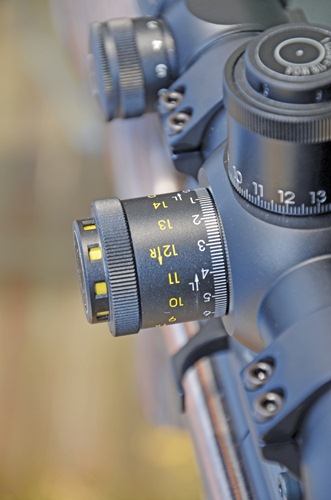
The small number in the window at the top of the elevation turret gives the number of the revolution where the turret has been adjusted to. Likewise, on the windage turret, once adjustments has gone past the midpoint and effectively towards a right bias, the turret indicator shows yellow.
Image quality side by side against a Nikko Stirling Diamond Sportsman (the highly popular mid-priced choice for many top shots) saw no huge advantage on a resolution test; which says more about the quality of the Japanese lenses of the big Nikko. What did jump out though, was the vastly greater field of view of the S&B, given that 34mm body tube. A visual advantage in the region of 30% when viewed at 55-yards, made target acquisition that bit easier, and sighting more relaxed all round.
This model can’t fail to impress. A technical specification to satisfy the most demanding of FT competitors, coupled with renowned build quality, and obviously top grade lenses, from one of the most respected names in the business, means it can’t be ignored. Get past the weight, or that eye-watering list price, and it just has to be a serious contender for Field Target Shooting - the flagship sport it was specifically designed for.

click on image to enlarge
click on image to enlarge
click on image to enlarge
click on image to enlarge
click on image to enlarge